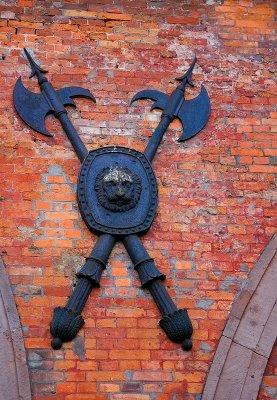
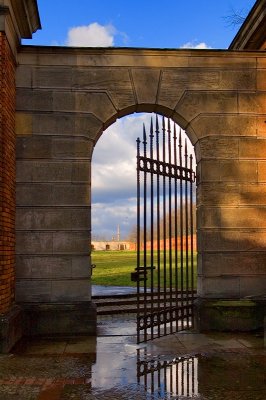
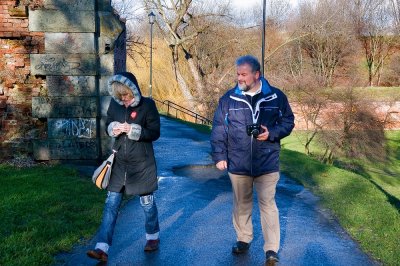
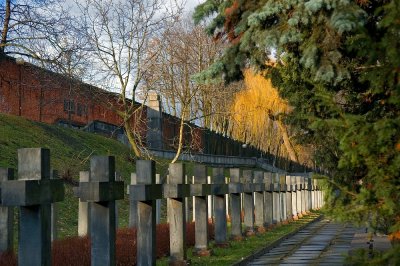
Alexander's Citadel, later called the Warsaw Citadel, was built by the Russian authorities between 1831- 1834, by personal order of Tsar Nicholas I after the 1830 November Uprising.
It was intended to keep this rebel city obedient and was originally constructed to house the Warsaw-based Russian garrison.
It's chief architect, Major General Ivan Dehn, used the plan of a fortress in Antwerp as the basis for his own plan. The fortress is a pentagon-shaped brick structure with high outer walls, enclosing an area of 36 hectares. The cost of construction came to 11 million rubles (roughly 8.5 tonnes of pure gold or 128 million euro by today's' prices), a colossal sum by 19th-century standards, and was borne entirely by the city of Warsaw and the Bank of Poland, as yet another punishment for the failed uprising. Work on it officially commenced on 4th May 1834, to mark the 18th birthday of Russian Crown Prince Alexander, for whom it was named.
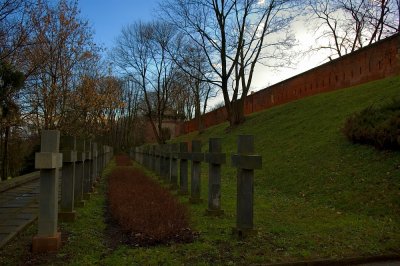
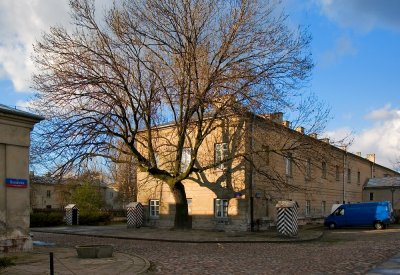
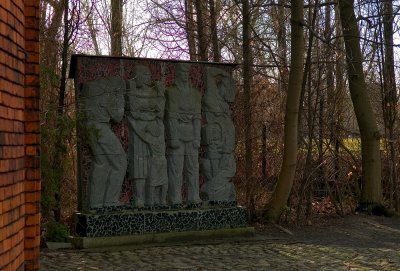
Soon afterwards, the so-called Tenth Pavilion of the Citadel began to serve as a jail for political prisoners. Their number increased dramatically after the tragic 1863 January Uprising. Throughout its 94-year history, the "tenth" housed over 40,000 prisoners; of these, hundreds were executed and thousands more exiled to Siberia. Among the Poles who lived behind the walls in the 1800s were revolutionary priest, Piotr Sciegienny and Romuald Traugutt, the last dictator of the Polish National Government, formed during the 1863 uprising. Traugutt was executed in front of 30,000 people on Aug. 5, 1864. It also housed a freedom fighter Jaroslaw Dabrowski, later military chief of the 1871 Paris Commune; Feliks Dzierzynski, a leader of the Russian Revolution of 1917 and founder of the Cheka secret police; the Marxist theoretician and revolutionary, Rosa Luxemburg; the future Marshal of Poland, Jozef Pilsudski and also Eligiusz Niewiadomski, assassin of Poland's first president, Gabriel Narutowicz.
After the outbreak of World War I, in 1915, Warsaw was occupied by German forces with little opposition from the Russian garrison, which abandoned the fortress and withdrew east. The Germans blew up several of its structures, but the main part of the Citadel remained intact. After Poland regained its independence in 1918, the Citadel was taken over by the Polish Army. The Citadel's infamous Tenth Pavilion was liquidated in 1925.
During the World War II the fortress survived the German occupation and in 1945 again became Polish Army property. Nowadays, since 1963, it serves as a museum. On the basis of diaries, archival documents and other sources, the entire building was recreated in the late 1960s: prison cells, corridors and underground tunnels were all reconstructed to their original appearance and atmosphere. The museum now exhibits old prison documents, 19th-century firearms, photographs of the better-known prisoners, and paintings by some of Poland's most renowned artists of the past. The Warsaw Citadel is one of the best-preserved objects of the 19th century fortification and defensive architecture.
Very interesting documentation of the Warsaw citadel, reminds me of the red brick Chateau de Salse which you can see on my gallery. Congratulations and thanks for posting. Peter.
Great gallery and it must be nice to meet other pbasers!
Guest
20-Jan-2007 21:23
I hope soon to place my tribute to this too :-)
This is a nice set of photo's and the others did also very well
It was nice to be together and we also took some historical info with us
Something to repeat; it can also be in Holland as well
Having done a few of these Pbase meet-ups, I can say that they have been among the most fun things that I have done. The people you meet are wonderful, and sharing a common joy of photography - such a great way to create new friendships. Wonderfully done!
ERROR: 500
NOTES: [hset] LOADING Redis is loading the dataset in memory, at /usr/local/share/perl5/Redis.pm line 268. ,
PBASE_ENV: production
Try Again:Go Home