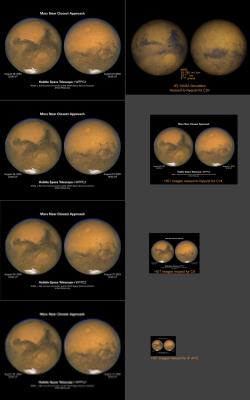
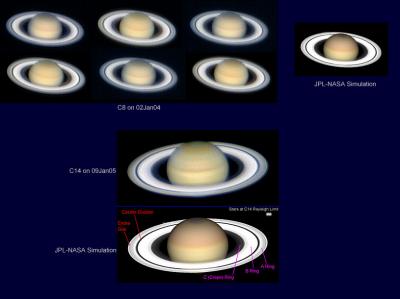
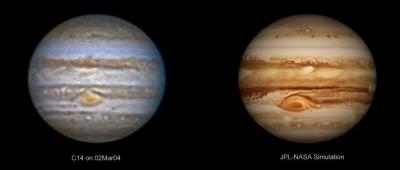
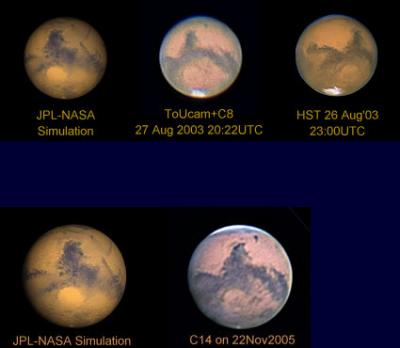
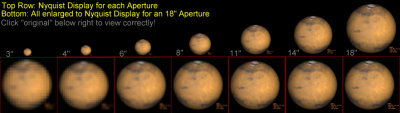
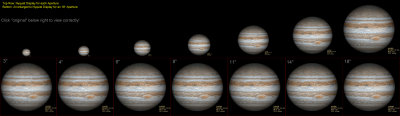
Planetary images are taken at widely different magnifications (focal ratios), using a wide range of telescope sizes (thus impacting available resolution) and quite widely varying distances from Earth (thus at different planetary disc diameters). This gallery tries to look at a sensible formula for determining at what size those images should be displayed on the monitor, so that one can easily judge the fruits of one's labour; and consequently gauge how much room there is for improvement, given the optical limitations of the equipment used. It's obvious that an image taken expertly by a large aperture scope, say a 20" Newt, can withstand being displayed at a larger size than one taken by a much smaller scope, say a 3" APO. Below we look at a simple means of being "fair" to both experts, by judiciously sizing each image at its appropriate limit. I will use my own (inexpert) examples of Mars, Jupiter and Saturn taken through a C8 and C14 to illustrate the sizing scheme in action. Text is displayed below each slide. To view the correct sizing please make sure that "original" has been selected, below each image. All my images were recorded using a ToUcam.