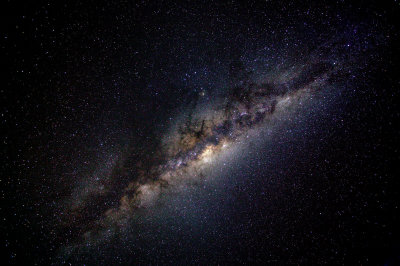
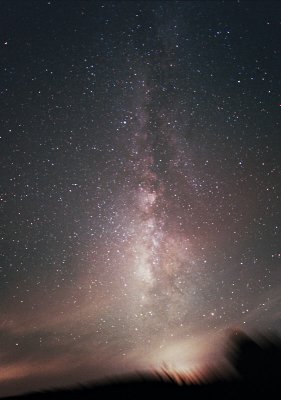
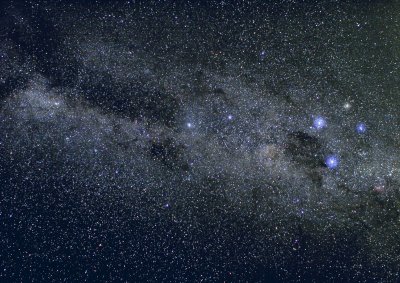
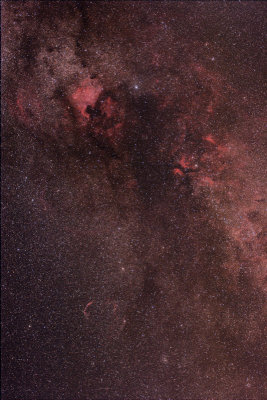
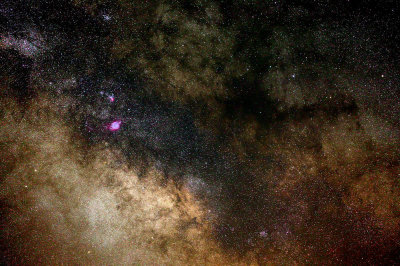
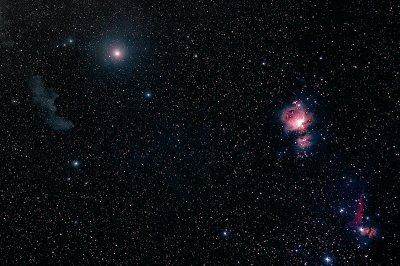
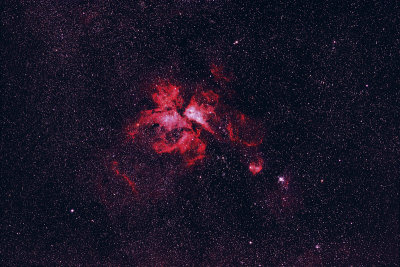
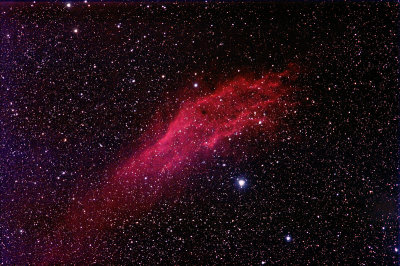
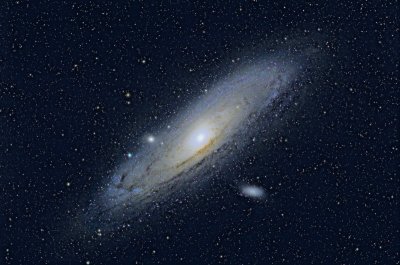
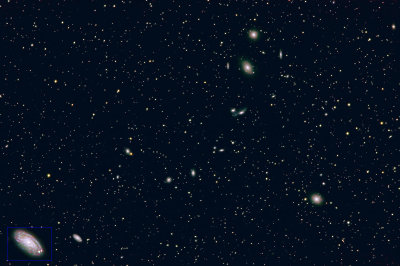
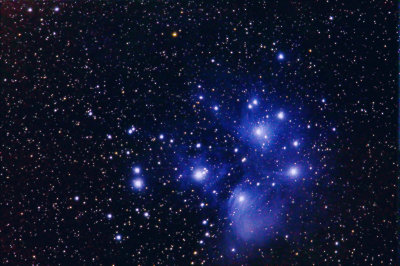
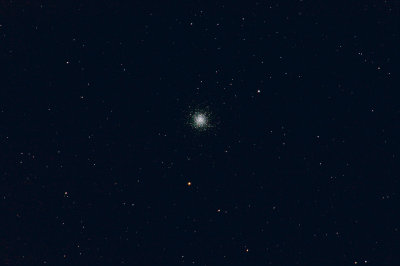
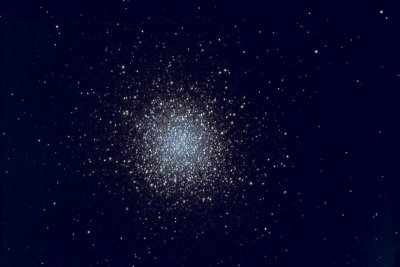
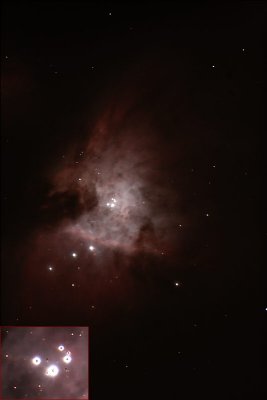
No, you do NOT need a telescope to make satisfactory images of Deep Sky Objects, the stuff (star clusters, nebulae and galaxies) that lie well outside our Solar System. Over the years I have taken a number of images of DSOs (Deep Sky Objects) and I thought it's time I displayed examples of what is possible with ordinary camera lenses, as an encouragement to others, using a DSLR. Basically, the shorter the focal length you use, the easier it is to track the sky, and the cheaper the tracking-mount you can get away with. Yes, you can even take Deep Sky photos with no tracking mount at all! Anyway, below please find examples starting with a super wide angle view using a 14mm lens on a full 35mm format DSLR (e.g. a Canon 1Ds or a 5D) and ending with a view using a 4000mm focal length C14 on an APS-sized DSLR (e.g. any of the Canon 1.6x crop cameras like the 20D, 40D, 400D, etc). A major advantage of camera lenses compared to most telescopes of similar aperture diameter is that camera lenses almost always have a faster focal ratio and a flatter image field (less-distended stars near the frame edges). A faster focal ratio means that you can use shorter sub-exposures and still have efficient stacking. Basically, even at the darkest sites on Earth you can get away with subs as short as 1-minute at f2.8, 2-minutes at f4, 4-minutes at f5.6, etc. This implies that there is always a short enough focal length and a fast enough focal ratio that any tracking mount can cope with, without autoguiding. E.g. even a fixed tripod can shoot reasonable 30-second subs using a 14mm lens at f2.8. Also important to note that you can get away with very short subs, 10 to 20 seconds on star clusters and dark nebulae (absence of stars, hence whatever length sub that can record stars can record a dark nebula!). However, camera lenses are basically limited to focal lengths under 1000mm, because beyond that, even a 150mm diameter aperture, like on a 600mm/4.0 lens or on any 6" APO, yields a focal ratio (e.g. f8 at 1200mm focal length) that is too slow for pleasant, unguided, DSO imaging. At f8 sub-exposures have to be at least 8-minutes long and autoguiding is a must with almost all mounts. So, commonsense leads many to prefer mirror scopes for focal lengths beyond 1000mm. But mirror scopes tend to be large and heavy. Focal lengths >1000mm and the consequent requirement for autoguiding make mirror scopes rather daunting for portable use. IMHO nothing beats camera lenses and DSLRs for pleasant portable (and unguided!) astrophotography :-) All but two of the images below were shot unguided. The only ones that were autoguided are the two images (M45 and M42) using 5-minute subs and 600mm+1.4x tele-extender (840mm focal length at f5.6). In those days I did not yet know how the skyfog, length of subs and focal-ratio interacted. Now that I am a bit wiser, I can get away with shooting even those two unguided. On any given night just use a planetarium program like The Sky to find a patch of sky that yields a pretty composition for your chosen lens...
Samir, which 14 mm lens make and model did you use for these pictures? Was it a fixed focal length or zoom lens? I am trying to find a 14 mm fixed focal without autofocus, but it is not so easy.
Wonderful work, and I appreciate the explainations. I've been trying this with limited success and your information is very helpful!
Guest
30-Oct-2008 12:19
You've taken a real load off my shoulders. I was sweating which lens to buy that would also let me get into astrophotography. No more! Gorgeous images.