![]() |
![]() |
![]() |
![]() |
![]() |
![]() |
| xdriller | profile | all galleries >> Irish Journal | tree view | thumbnails | slideshow |
Ann and I arrived in Dublin on Aer Lingus (on time at 5:50 am), got through customs and were in our rental car in little over an hour. Taking the road out of the airport would take us directly to our hotel. It is impossible to get lost since the hotel is on that same street only a few miles away. We got lost. We got so lost we needed help. At a gas station, Ann went in to get directions. She came out with a truck driver who said he would take us there. I don’t know how she managed this coup. I don’t think I want to know. Following his truck cab (no trailer) he got us to the hotel. It took twice as long getting to the hotel from the lost position that it should have taken from the airport. We thanked him and off he went. It was 8:00 am and we could not get into the room until 3:00 pm. Neither of us had slept on the plane which helps explain how we got so very lost in an English speaking country.
Off we went into Dublin by bus feeling unbelievably ready to take on the world (read: Adrenalin rush). After Trinity College and seeing the Book of Kells we rode the on/off bus around the town getting off when we wished. Before we got to the Guinness Brewery for the much anticipated tour and complimentary pint of this dark beer, we read that the free beer cost is really $18 a person for admission to the tour. I refused the free $18 pint of Guinness.
We passed that stop and went to the Kilmainham Gaol instead. This is an 18th century prison that has housed most of the rebels of the several failed attempts at Irish independence. It also housed people who during the famine opted to commit a crime and go to jail to have a roof over their head and a starvation diet rather than starve in the streets. It is a 45 minute gruesome tour of cells and execution sites. After that, we were ready for lunch!!
Lunch at a nice outdoor café and a pint of beer (Guinness – and $13 less than at the brewery!) for each of us just about did us in. The lack of sleep hit us at the same time - the beer helped. Ann found a new friend, Smithwick’s Ale. We staggered back to the hotel with the help of a local bus and watched the last of the first day of the British Open Golf Tournament. I fell asleep by 7 pm.
Dublin should be an interesting city, rich with centuries of history, literature and rebellion against the English. Unfortunately this town feels lacking in substance to me. During the 1916 rebellion to overthrow English rule, the English literally destroyed the city. Little remains of buildings before the 20th century. What is present is a city that was built from the 1920s on, much like an American city of undefined architecture. There is no quaint old town historical center seen in so many European cities and no new vibrant city core recently revitalize as in some American cities. But there is a beautiful Christ Church - that was closed for the week for the filming of a movie.
It is a city that needs to be seen – once.
Breakfast in the British Isles is like waking up in heaven. With no dinner the previous night we were famished. My breakfast consisted of: Tomato juice, grapefruit and mandarin orange sections, toast and marmalade, grilled tomato, link sausages, English bacon, scramble eggs, baked beans, famous Irish brown bread and coffee. I was then no longer hungry. This is from someone who has trouble getting down a bowl of cereal for breakfast at home.
The newspaper headline for one of England’s newspapers today was: Two Months Rain Today. It seems that a huge storm is coming up from France with up to 4 inches of rain possible – the normal total amount for July and August here. Unfortunately the paper did not lie. On the way to the Powerscourt Gardens south of Dublin, at times I could not see much ahead of our car on the motorway because it rained so violently. Worse, at the gardens the rain was constant. We were the first people at the garden that day at 9:30 and left soaked from the rain at 11:00. This is not the most desirable way to see a garden since usually gardens are located outside. The garden was magnificent and still enjoyable since rain is now a part of our Seattle life.
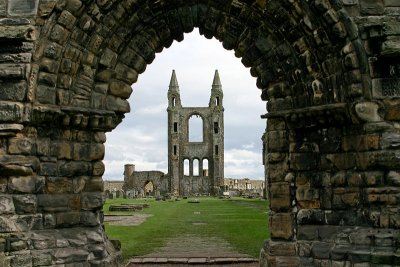
The highlight of the day was Glendalough, the ruins of a monastic site begun in the 5th century adjacent to two lakes in a narrow glen further south of Dublin. The rain was still present but more of a Seattle drizzle thankfully. The guide at this Irish Heritage Site was enlightening, sarcastic and humorous with much information about early Christian Ireland to impart.
After arriving at Newton’s Country House B&B outside of Kilkenny we headed into town for a look around and a pub dinner. In the center of town we parked in a large pay car park along the river. When we finished dinner Ann could not find the car park ticket. Fearing a 50 Euro fine ($80) she frantically looked in every pocket, every purse place and each section of her wallet over and over again. She even resorted to dumping out the entire contents of her purse and wallet. When we parked earlier, she told me condescendingly that she should hold the time ticket so I wouldn’t lose it. Not so funny now is it ANN? She did find it fortunately (or unfortunately – I can’t decide). The fine would have been a very manageable 10 Euros we found out…
At dinner in a large pub in the center of town, we sat next to a young couple. They were traveling almost the exact route we were. From north of Toronto, they were both teachers and had been married for exactly one year. It reminded me of two other starry-eyed youngsters traveling in Europe exactly 36 years ago who were celebrating their one-year anniversary at that time.
We awoke to headlines of Midsummer Monsoon in an England Newspaper. Nearly 10,000 people in the Midlands of England had been stuck all night in their cars on flooded motorways. Stores were flooded and houses cut off from exit routes in some areas by overflowing rivers. In Ireland it has been wet but not ridiculous. Rain began at breakfast this morning but ended by the time we drove off; fortunately, not to return the rest of the day.
First stop was to the ruined Jerpoint Abbey south of Kilkenny. Actually most Catholic churches and abbeys in Ireland were destroyed in the 1600s by Oliver Cromwell’s Protestant armies rampaging through the country attempting to destroy any vestiges of outlawed Catholicism. It obviously didn’t work long term but just another reminder of the idiocy of Protestant fanaticism, and Catholic fanaticism and Islamic fanaticism, etc.
At the abbey we again had a wonderful, knowledgeable guide from the Irish National Heritage, who administers the sites. I am now an expert on Irish monastic life from 450 until 1200 at Glendalough and from 1200 to Cromwell’s destructions in the1600s here at Jerpoint. Needless to say, Ann is in her environment sucking in even more of these talks than me since I wander off at times to take pictures.
After our educational morning, off we went to the Hook Peninsula. The lighthouse at the point is the oldest working lighthouse in the world. Built on a Norman design it is not quite round and no longer completely vertical but a magnificent structure that stands defiantly on the rocks of Southern Ireland. Walking on the rocks around to the back of the lighthouse, I met and elderly Irishman (Elderly means 5 years older than me, unfortunately). I don’t mean to speak stereotypically about national traits but did man of Ireland ever have the “gift o’ gab”. We ended up talking about his trip to Waikiki and how the travel brochures and National Geographic did not describe the islands correctly. It was BETTER he said. He loved being on the 30th floor overlooking the white sandy beaches and the Pacific Ocean, basking in the warm temperatures and the gentle trade winds. He thought that was as good as it gets. Here I am on these rocks jutting out into the Irish Sea below a lighthouse that has stood for centuries thinking the same thing – this is as good as it gets. I wondered how he could ever appreciate Hawaii more that this.
Off again to our night’s lodging in Tramore, County Waterford. We stopped at the seemingly deserted village of Arthurstown at the entrance to Waterford Bay. Overlooking the water was a pub, The Strand, of no particular significance. This is where we would have today’s pub lunch. We each ordered a pint of Smithwick’s Ale and a cup of fish chowder. This chowder was more like a creamy fish stew with multiple layers of delicate flavors amid abundant shellfish and whitefish, a bowl created by a very talented cook. We savored every spoonful. This is not the beans and toast pub lunch with a pint we had in the 1970s but it did not cost $1.50 like back then either but over $20. Food and alcohol is very expensive in Ireland. Now with the Euro at a staggering $1.39 the exchange rate is 20% higher than two years ago ($1.08) adding to the high cost of everything. Rumor has it that Ireland and Finland are the two most expensive countries of Europe at present. Wonderful.
The town of Tramore reminds me of Seaside, Oregon, a beach resort with a quarter mile deep sandy beach when the tide is out. Cheap shops, many indoor arcades and a semi-permanent carnival-like attraction adorn the waterfront. Our B&B is up the hill overlooking it all. The owner has a beautiful garden so she was Ann’s “New best friend ever” immediately. I was more taken with the high definition flat panel TV in our room until I found out it received only four different channels only one in HD. I would rather have had internet access.
We awoke, had breakfast and were on the road a shade after 9:00. We arrived in Killarney at 6:30 after three one hour stops. That means over six hours of driving, all on narrow, winding two lane roads. Although the speed limit in all areas except towns was 100 km/hr (62 mph) we barely averaged 35 mph and there were few towns and very little traffic. We drove along the southern coast in lanes that were too small for a car to pass in opposite directions without trepidation and then through moors with the same type roads.
We traversed two mountain passes where the lanes got even narrower with more severe curves. Here balanced on the side of a cliff we had more than a few heart-stopping moments when a car, a motor home or a huge tour bus passed inches from the side of our car as we were inches from the edge of the cliff – and this was at 30 mph down to a dead stop. To add to the excitement of this day’s drive the weather was dreadful. The rain, at times, was quite severe with water building up on the roadway. The shocks in our rental car squeak with the uneven roads and the brakes screech while slowing. Apparently Dan Dooley Car Rental is not Hertz. All-in-all this was a rather interesting day.
On the non driving side of the day we stopped in Kinsale, a Carmel like town, on the coast south of Cork. There we walked around but did little else. Taking the slow southern route, we stopped for lunch in Bantry at the head of Bantry Bay. The weather was closing in so rapidly that we have no idea what the environs of Bantry look like.
Now here is an interesting thing in Ireland. Sunday at 1:30 is NOT the time to have a nice meal since every Irish family, every tourist and anyone else not in those categories is having a Sunday meal at this exact moment. Be it a pub, a tavern, or a restaurant, tables are scarce. We lucked into a nice restaurant for an outstanding meal at a reasonable price. Ann had roast lamb while I had haddock. Well prepared, large portions and decent prices. As we paid our check the skies opened up. That was the afternoon weather until we arrived at Gorman’s Country House B&B outside Killarney.
Catching the 18th hole and playoff of the British Open on our room was a delight since the Irishman, Padraig Harrington, beat the Spaniard, Sergio Garcia. The BBC commentators were happy beginning the playoff since the two were Europeans, not American. With the victory by Harrington the entire Irish nation celebrated the great accomplishment of their countryman.
Dinner was in Killarney. Actually a pint for each of us in a pub was dinner. I had a Kilkenny, a lighter version of Guinness. It was quite good. By mistake I ordered Ann a Bulmer’s. She got a pint of hard cider. The dear lady drank it like a trooper but I am not sure she would not have rather had a Smithwick’s, her new personal favorite draught ale. The local lads in the corner were arguing about the last time an Irishman won the prestigious British Open (It was 1947 if anyone cares).
Sleep came much too easily at 9:30. I guess traditional Irish music and dancing will happen tomorrow. It is a sad state when our B&B hosts, James and Moira O’Gorman are going out the door for an evening of music and dancing while we are coming in the door to collapse into bed. I can hope it is because they did not drive the roads we did today - because our ages are too similar.
The day dawned with red skies and a few clouds. Perhaps the weather will change for the better today. At breakfast James, our host, gave us the itinerary for the Dingle Peninsula.
It was a splendid day, both weather and sights. The Dingle Peninsula is unmatched for spectacular natural beauty. The mountains arise from the north coast, the Bay of Tralee and the south coast, the Bay of Dingle with high mountains forming the spine. From sea level to 2700 feet the mountains dramatically rise from rocky coves and inlets. Today the mountain tops were shrouded in mist but the sky was blue with huge, white puffy clouds.
James had suggested we travel to Dingle Town by way of the Connor Pass. This is a pass across the mountains that create this peninsula. The alternative is staying on the coast roads. Up we went from the north side of the mountains toward the south. I mean up we went! Clinging to the side of the mountain this two lane road (yes, narrow two lane road) appeared to get narrower and narrower as we approached the summit. Near the top, yes, it became a single track road which would be no problem if no cars wished to come down from the summit. Some did. Being the upward bound car they had to yield to me and back up into the nearest lay-by. I liked that. I was the winner with each encounter – I was undefeated to the summit.
At the top was a vista point, 1500 feet below was the town of Dingle bathed in a solitary shaft of light against Dingle Bay with dark clouds above and shadows across the downward slopes of the mountain – a view I will remember forever. I will also remember James’ warning about driving down the steep road from the summit into Dingle Town in a particularly Irish sentence, “Common sense must prevail”.
We arrived in Dingle Town about 10:30, had a cup of coffee and left for the trip around the tip of the peninsula, Slea Head. Traveling around the point itself, the road narrows to single track. Here we were front row center to view a HUGE tour bus meet a poor little car with no space to pass. Since the bus was huge and the car was small, the car eventually realized this encounter would not have a David and Goliath result. The giant will win here. The poor little car backed up for what seemed like 500 yards before the road widened just enough for the bus to pass. By this time the line of cars behind the bus had numbered over thirty including us. After the bus passed, the poor little car had to wait for all of the cars behind the bus to very slowly pass him. Humiliating for him but I was on the winning team again!
Completing the loop brought us back to Dingle Town at 2:00 – lunch time. Earlier in the day had seen a flat roof single story building across from the wharf. This place was painted bright blue, I mean electric blue, and the kind of “dive” that was common on the Pacific Coast Highway in the mid 1960s at LA beaches selling greasy taco strips and hamburgers. Not a place I wished to eat. Yep, we ate lunch there. It was a restaurant called Out of the Blue. It served fresh fish. Get it? Out of the Blue (fish out of the ocean). If the weather is horrid and the fishermen do not go out there is no fish in the morning and the restaurant does not open - simple as that. The fish was as fresh as described. Ann had plaice and I had gambas, whole shrimp (heads, legs and all) sautéed in a Thai hot sweet sauce. Wine complimented the meal and we walked out satisfied. I did not expect to find food of this quality of preparation in far Western Ireland. The food has surprised and delighted both of us on this trip.
We pulled a “fast one” thanks to Rick Steves’ Ireland tour book. There is a tiny stone Christian church, Gallarus Oratory. It is the oldest existing church in Ireland dating from 600. Made only from dry stacked stone, both walls and roof, it has been essentially untouched since. The slate was fitted together so perfectly that it is still completely waterproof after 1400 years. Anyhow, I digress. The fee is three Euro per person to visit. The fee is really to pass through private property that the owner of the property has made to look like the only way to get to it. The fee goes into his pocket. Rick said to drive another 200 yards up the single track road to a small parking area and take a narrow path lined with fuchsias ten feet high to the tiny church. We did and felt very smug with the free viewing, especially since we were earlier “taken” for three Euro each in the same manner to see a 4500 year old Stone Age fort hanging on the cliffs outside Dingle Town. The difference was that there was no other way to get to the ruins of the fort without slipping and falling off the cliff several hundred feet into the water.
The Dingle peninsula irritates me in one respect. I like fuchsias. Here they grow like weeds, but just one variety, and they are in full glorious bloom of bright red flowers in July. Some are over 20 feet tall; some are shorn back from the roads into a hedge. Since it rarely snows here, because of the warm ocean current, they just keep growing not dying back each winter. The people of Dingle are beginning to despise these “weeds” since they cannot rid themselves of these lovely red flowered plants imported from Australia by a landed lord. Western Ireland gets no snow but over 100 inches of rain a year – a third of Seattle’s rainfall. I would rather have less rain and smaller fuchsias, I guess.
Off now to dinner then music and dancing (to view not participate!)
We have just arrived back from an experience I cannot believe. We ate at the White Gate pub in the heart of tourist Killarney. Expecting to be overwhelmed by Americans from the tour busses spending the night, we weren’t. Few people were in the pub until 9:50. The music and dancing begins at 10 pm. Within minutes the place filled up with locals and the band set up inside the pub. The leader of the band called for the forming of the sets. With that 32 people from around the pub strolled to the dance floor. They formed up with four groups of four couples creating four separate dancing ”squares”.
To the beat of incredibly fast traditional Irish music the 32 people in four groups began dancing reels, jigs and any other number of dances I do not know. At the start, the immediate noise in the room was stunning. The music and the stomping of shoes on the wood floor were deafening. Each musical piece was transformed into a particular type of dance. The energy expended makes Riverdance seem like a calm stroll. The couples danced much like in square dance form without a caller but everyone knew exactly what to do at all time. They spun their partners with dizzying speed while clogging around in a circle, kicking up their heals and unexpectedly jumping into the air for no apparent reason. They exchanged partners and at times engaged in individual steps for the length of the music piece. One music piece ended then the next piece of music began then the next. The dancers never varied their collective and personal energy. The ages of the participants ranged from young adults to people I felt ashamed to be in the same room with. The oldest seemed to be well over 70. The first set ended after almost 90 minutes. The participants were sweaty and exhausted. I was too, except the only energy I expended was hoisting pints of Guinness and sitting in wide-eye amazement at what I happening before me.
Arriving back to the B&B late, James explained that these folk do this once, twice or even three times a week but every night a group seems to form. He and Moira go to another pub to dance in a village just north of the house but the best music and best dancers, he said, is where he sent us.
At breakfast today at our second night in Killarney, James advised us “that the early bird catches the worm” meaning that the weather will be fine in the morning but degenerating in the afternoon - so get moving. He knew we were going to the Cliffs of Moher today. Viewing 700 foot vertical cliffs rising from the Atlantic for 5 miles along the coast should not be viewed in either fog or rain.
Off we went for the 3+ hour trip north up to the Shannon River, across the Shannon Estuary by ferry into County Clare and up the western coast. Of course we were on two lane roads but wider and less curvy than the ones we had previously traveled. I had never heard of the Cliffs of Moher two months ago. Now it was my mission to see them. I had worried the entire trip that the weather would provide poor visibility. As we drove north the clouds increased in number and darkness. Rats.
Arriving there the skies opened to sunshine just for ME. It struck me that if I had never heard of the cliffs before two months ago then obviously neither had anyone else. Coming over the hill to a HUGE car park and visitor’s center was disturbing. I had envisioned Ann and I being he only people on a lonely windswept Irish cliff 700 feet above the dark, churning waters of the North Atlantic Ocean braving the stiff winds to view an incredible natural wonder. Well, everything was correct except the “…Ann and I being the only people…” part.
It was, to be sure, dramatic, spectacular, dizzying and terrifying at the same time viewing these vertical cliffs from above dropping straight down into the swirling sea. Without the benefit of a guard rail or any structure between me and the ocean below, standing a couple of feet from certain death if I slipped gave the viewing a certain drama not present when, let’s say, viewing the Washington Monument. I was in awe of the Cliffs of Moher. Even Ann climbed out over the slate ”Private Property” fence to get a better view beyond the Do Not Enter sign. I was very impressed with her courage. We found out about a 20 year old Hungarian visiting friends south of here in Kilrush. He did not return from a walk along the cliffs. His body was found in the water last Sunday.
After lunch in the quaint town of Doolin, at a pub, Smithwick’s this time not Guinness, we traveled further north into The Burren. This is an area of stark beauty: Without soil, only limestone rock covers the surface. There we viewed a Neolithic above ground burial chamber 5000 years old made of large slabs of the local limestone. Above ground since there is no earth to dig into only stone.
We checked into our B&B in Lisdoonvarna and amazingly there is wireless internet service in the house. The first time!
In the evening we ventured into this tiny village to sample the local authentic Irish music. Out here in the far west rural towns the music is supposedly the best. We were directed to the best band playing which was playing tonight at the small Rathbun Hotel, a small inauspicious structure at the crossroad that was the town. Now, here expectation exceeded reality by a large measure. The music was to start at 8:30 in the pub/restaurant/meeting hall combination room. We arrived at 8:15 to a warm up group of four young ladies whose ages I would guess to be 14 to 19. They played and sang traditional music. At 8:30 they played on. We waited for the real band to play. At 9:00 they still played on. Finally at 9:20 we left realizing this WAS the main attraction of the evening. I felt it would be rude to ask the barkeep when the main band was coming on if this was the main band. They were not really bad but not really good either. We left after one pint with the knowledge that we had seen and heard all there was this evening in Lisdoonvarna.
Up, breakfast-ed and on the road from Lisdoonvarna (I dare you to find it on a map!) by 9:00. We were headed cross-country from the west coast to the east coast for our last night in Ireland. Today would take us to Trim Castle and the ancient ruins of Newgrange in County Meath.
The ruins at Newgrange are Stone Age. For non-paleontologists like me that means 5500 years ago or 3500 BC, I think. The burial mounds abound with over 45 in the area but there are three major structures. We visited one. This area is about an hour from Dublin. Because of this Newgrange is overrun with tourists. Being a tourist I don’t understand why I hate tourists so much. Ann would say that it is because I feel the world revolves around me and tourists get in my way. I really cannot disagree. Anyway, we arrived late in the afternoon with Rick Steves’ knowledge that it can become so crowded in the summer months one may not get in since the tickets are limited for the shuttle bus and guided tour.
We arrived at 3:30. The good news was there were tickets; the bad news was that our tour would begin a 5:15. The tour lasts over an hour. We waited. We watched a 5 minute movie in the Interpretive Center. We waited. We walked through the museum of Stone Age life and customs (very interesting). We had a cup of tea. We waited. Can you tell waiting is not one of my strong points?
Finally the appointed time happened and we were led to the shuttle bus for a several minute ride to the largest of the burial mound chambers – 328 feet in diameter. Outside much information was given by the guide about why it is believed the structures were built and how the alignment to the sun at the winter equinox influenced the design. The huge stones used for the walls were laid flat, higher up they were staggered inward to create a domed roof. Each of these stones weighs between 2 and 10 TONS! More amazingly, they were brought 10 kilometers from their source through forest and bogs and rivers without the use of dray animals or the wheel. These boys did some serious work. It has remained completely waterproof for over 50 centuries.
To enter, we went through the low, narrow passageway. The passage aligns exactly with the sun at sunrise on December 21 creating a shaft of light through passage to the heart of the central room once a year on that morning, the shortest day of the year, for only 17 minutes. The passageway we entered is only 4 feet high and as narrow as 15 inches wide in some places and about 80 feet long.
After traversing the passage hunched over and sideways at times, we opened into a circular chamber of some 15 feet in diameter and at least 20 feet high. Standing upright for the first time in this lighted area shows the multitude of several ton stones above our head closing together to complete the dome and finished off with a huge capstone. The first thought is terror realizing you are betting your life on something built 5500 years ago with a dry stack only – no mortar. There is nothing to assuage that feeling in the pit of the stomach as you listen to the 15 minute lecture about the carvings on the walls and uses of the three small rooms coming off the central chamber. I found it impossible not to continually look up to see if any minute movement was occurring in the arrangement of the boulders above my fragile head.
We made it out without incident, alive and well. Off we went to our B&B, dinner and sleep in the coastal town of Skerries, near the airport, for tomorrow we return home.