12-DEC-2006
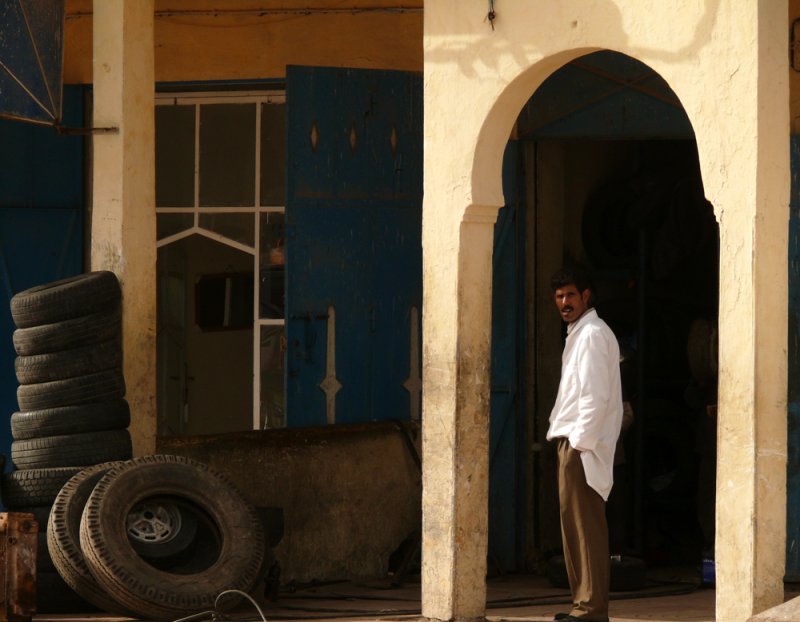
Facade, Jemaashin, Morocco, 2006
The shape of this doorway is elegant and traditional. It could be an entry to a mosque or Kasbah. Yet its sides are scarred and covered with dirt and it gives entrée to piles of used tires. The image is full of incongruities and facades – another door, ornate and massive lies open just to the right of the tires. The man who stands in the doorway is also incongruous. His white shirt is spotless, yet it hangs over his trousers. He stares at us with incomprehension – he probably can’t image why we would want to photograph a battered doorway and a pile of old tires. The doorway is the key to the image. As a symbol it is meant to promise much, but the realities show it is nothing more than a façade.
08-DEC-2006
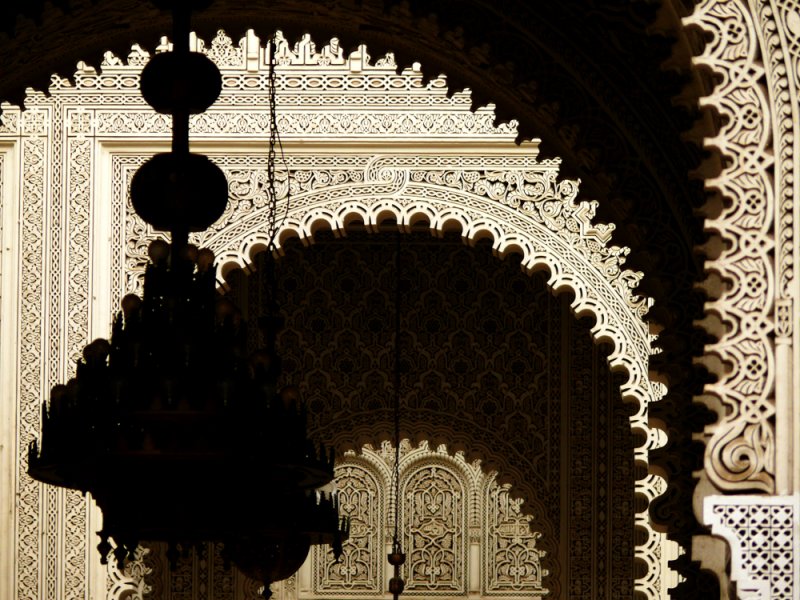
Resident General’s Palace, Casablanca, Morocco, 2006
France's first Resident General of Morocco, Marshal Hubert Lyautey, made this opulent palace his Casablanca home in 1912. Today it is used for administrative purposes, its faded elegance reflected in its ornate arches and doors. This image was made in the palace’s interior courtyard. I create layers of arches here – the first is a softly focused close-up of the ornamentation at right. The next is the shadowed arch, which supports a massive chandelier. The middle layer is façade of the palace itself, followed by layer of shadowing, giving the image its sense of depth. The final layer is the most unusual – the ornate shadow of the crenellated arch itself superimposed on even more ornately carved palace doors.
11-DEC-2006
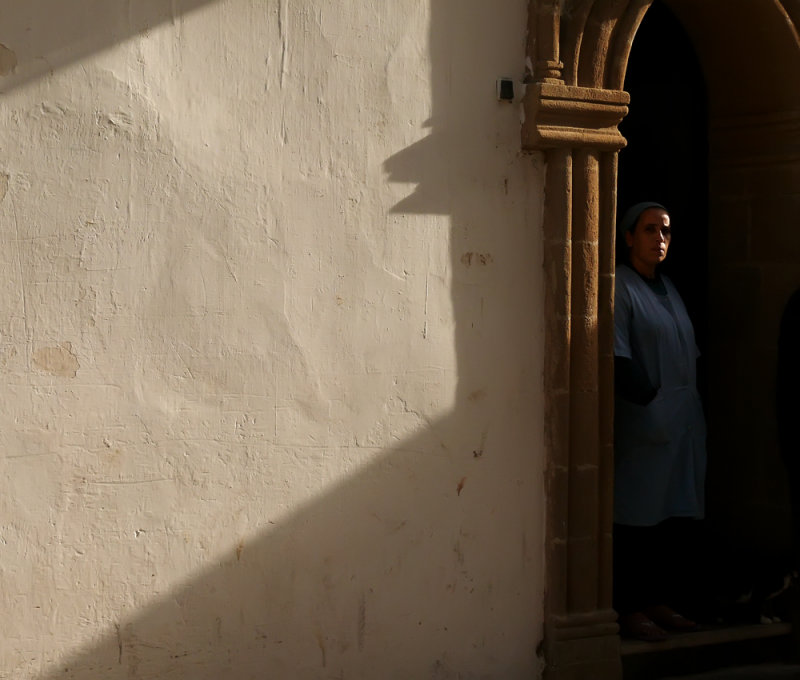
In the shadows, Essaouira, Morocco, 2006
Nearly concealed in the shadows, an Essaouiran woman begins her day chatting with neighbors from her doorstep. The long shadow cast on the wall of the house invests the image with importance. She seems strong and powerful hiding in the shadowy door way. The blackness within has abstracted her, suggesting her strength.
27-DEC-2006
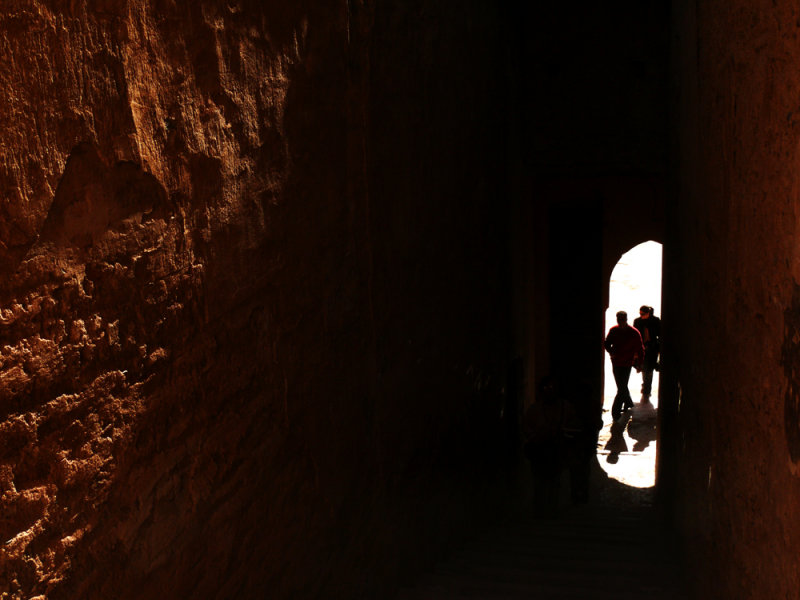
Stairway, El Badi Palace, Marrakesh, Morocco, 2006
Also known as the Palace of the Incomparable, this 16th century ruin has lost its beauty but retains its mystery. This is why I made this image – I photograph the textures of the sun-drenched wall at left, which quickly yields to the darkness of a public stairway to the Palace’s upper terrace. Within this darkness there is a patch of light containing a doorway, two visitors and their shadows. The tiny people are overwhelmed by the size of the castle they are about to explore. This image is all about mystery. In a ruin this large, the mysteries are large as well. (The palace had 360 rooms, took twenty five years to build, and was destroyed only 100 years after it was finished.) The tiny people entering a small door in a large black void symbolize the size and depth of those mysteries.
29-DEC-2006
Decisive moment, Marrakesh, Morocco, 2006
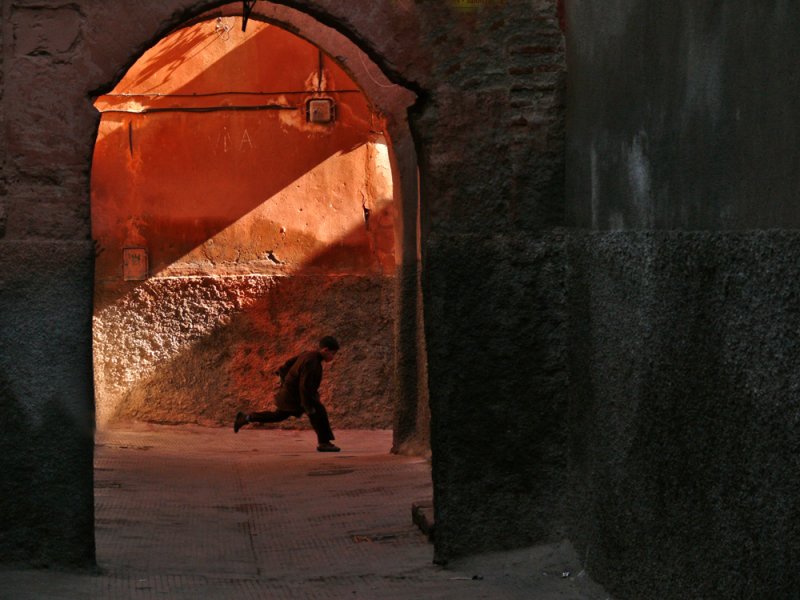
This is a very special photograph, a spontaneous moment of pleasure caught in a Moroccan environment. I was walking through the souks of Marrakesh when I saw a shaft of sunlight illuminating an ancient wall within an archway at the end of a dark and narrow street. I heard the distant voices of children at play, getting closer and closer. I framed the shot and waited, and within a few seconds a kid came flying into the arch. I squeezed the shutter button and caught him just as he landed. The magic of photography will always keep him in this spot, framed in fiery red, a symbol of youthful exuberance. An arch constrains motion – there is hardly room to move within it. The shutter of the camera has also constrained motion here, catching it within a specific – and decisive -- moment in time. The spatial constraints of the arch offer the very tension that holds this image together.
27-DEC-2006
Scars of time, El Badi Palace, Marrakesh, Morocco, 2006
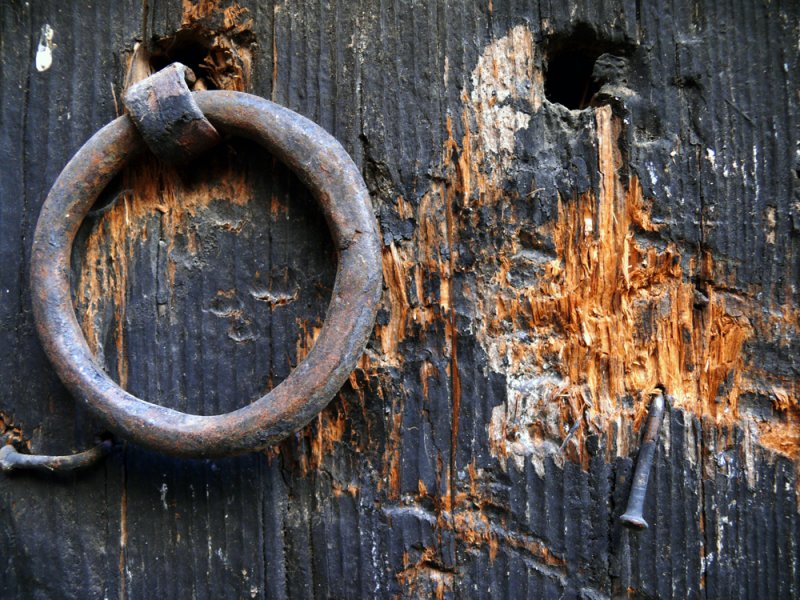
This is a door to one of the many rooms that Sultan Ahmed Al Mansour built to house his guests back in 1578. Today his palace is in ruins, and a close-up image of this door symbolizes that ruination. We see every gouge, hole, and abrasion – and note the rust on the doorknocker, and the jagged hole that presumably once held another. The bent nail and the raw wood just above it represent more contemporary ravages. At the end of the 17th Century Sultan Moulay Ismail tore out the palace’s marble, onyx, gold, ivory, and exotic wood, moving it all to his own imperial city of Meknes. The demolition took ten years. He must have spared this door. But time did not.
29-DEC-2006
Bab Agnaou, Marrakesh, Morocco, 2006
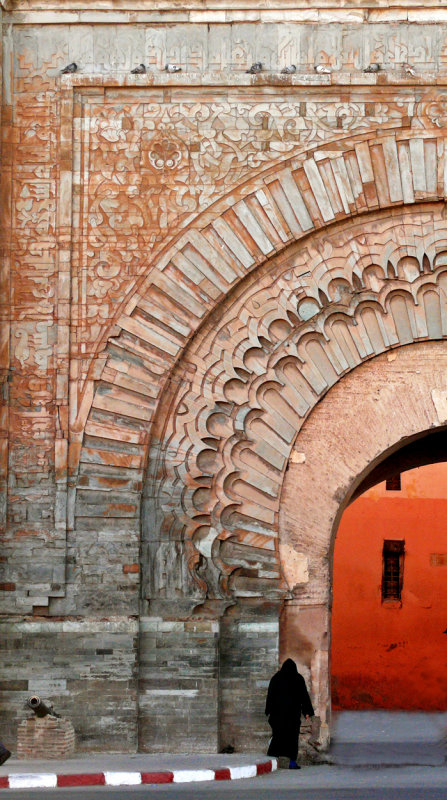
The most beautiful gate in the ramparts of Marrakesh, this 900 year-old arch once led to the Royal Palace. Its carved sandstone still shows tinges of red, melding with grayish blue. The sculpted facade consists of alternating layers of stone and brick. To make this gate speak more effectively, I abstract the image by cropping it exactly in half. I kept the half with the person about to walk through the gate to offer a sense of how huge this gate really is. The elaborate detail on its façade tells still another story, and makes another image unto itself. You can see it by clicking on the thumbnail below.
15-DEC-2006
Leaving the medina, Meknes, Morocco, 2006
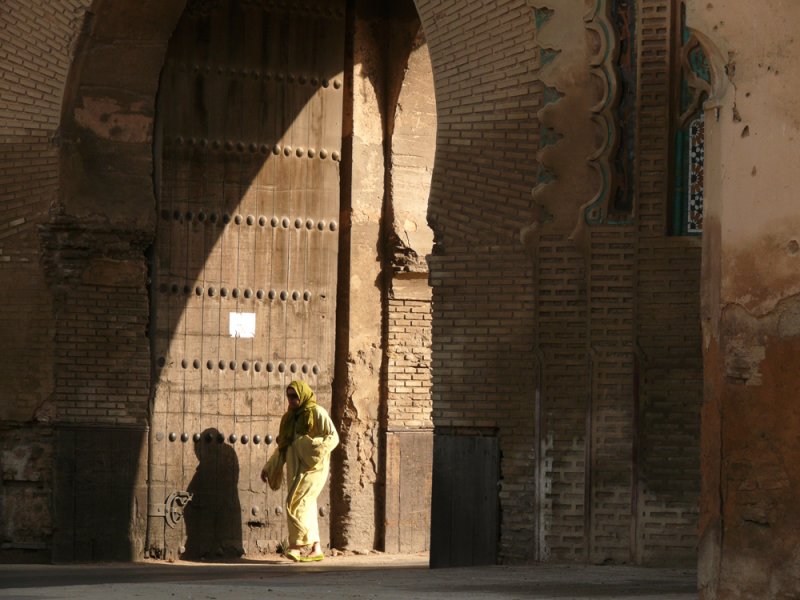
Meknes, one of Morocco's three imperial cities, ruled the country in the 17th century. It was the capitol of Sultan Moulay Ismail, among the greatest, and certainly most ruthless, rulers. He built this gate, the Bab el-Berdaine, which is still used to enter and leave the city's medina or historic old city. In this image, I show even less of the gate than in the previous photo. I abstract the gate down to its door and shadowy entry, and waited for a suitably dressed figure to enter the frame. The elegant ornamentation of the door is barely suggested in the shadows. This is image is not about beauty. It is about living history.
27-DEC-2006
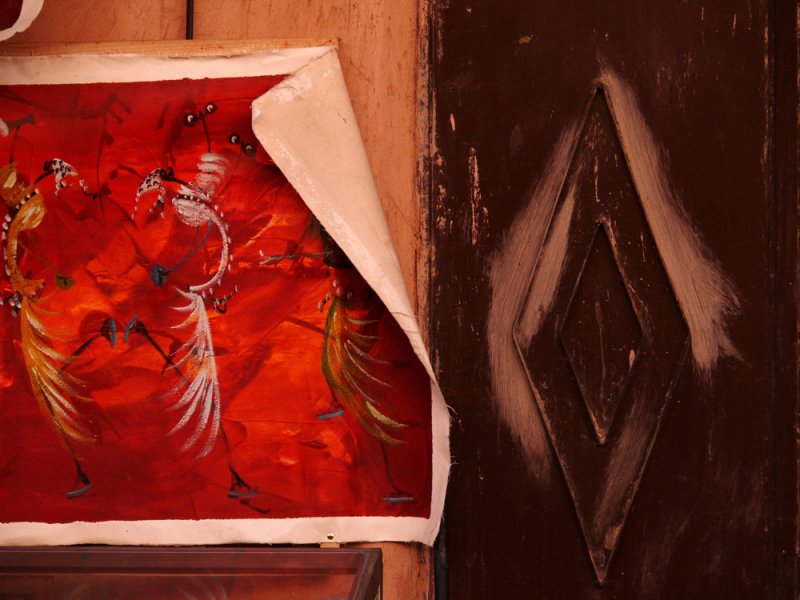
Coincidences, Marrakesh, Morocco, 2006
A Marrakesh merchant is using this door as an easel to display the art prints he is selling. I moved in on the print, cutting it nearly in half, stressing the triangular flap that is bent backwards over its corner. I stressed the flap because its shape echoes the double triangular molding on the door. Incredibly, someone has also embellished the door molding with a flowing feathery white fringe, coincidentally echoing the feathery white skirts worn by the elongated dancers on the print. The entire image seems to be in motion. There is a wonderful lesson in this for us – doors can tell stories, accidentally or on purpose. Discover them, and interpret them.
09-DEC-2006
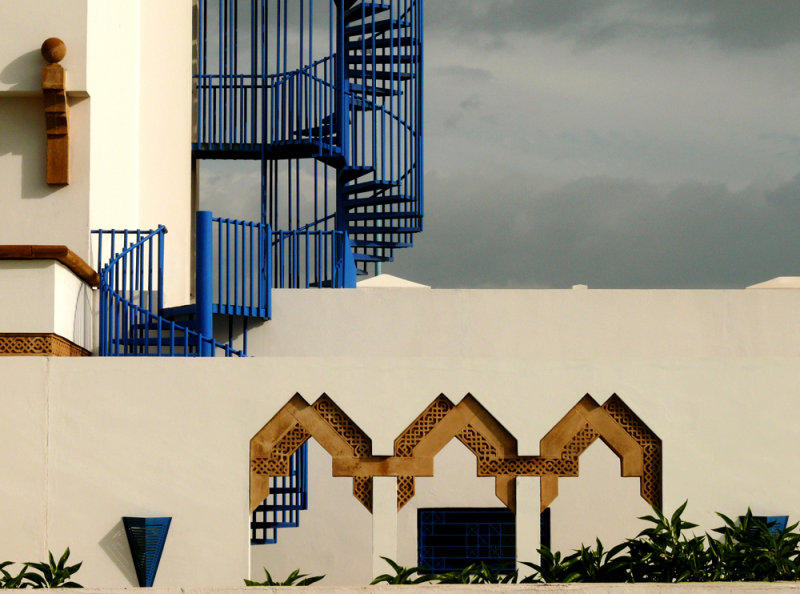
Ambiguous gates, El Jadida, Morocco, 2006
This hotel complex on the Atlantic Ocean at El Jadida uses cubistic design to establish its style and tone. While the blue exterior staircase is architecturally striking, I was particularly attracted to the stylized arched gates at the bottom of the frame. They seem to be asking the viewer to guess how much “gate” is really there? Can we walk through them? And if so, how far can we go until we hit a wall? Using the three dimensional perception of our own eyes, such questions are easier to answer. But the eye of the camera is two dimensional, and this image alters our perception enough to make the gates look fascinatingly ambiguous.
14-DEC-2006
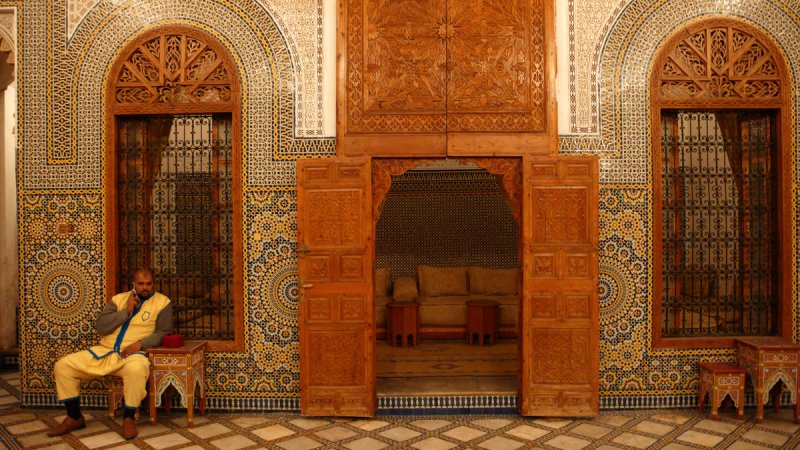
Riad, Rabat, Morocco, 2006
Rabat's Oudaia Kasbah is its old city, a splendid warren of 17th and 18th century houses lining the twisting, narrow streets. We saw the interior of this lavishly decorated riad (traditional residence) because our tour guide knew its caretaker. We found him talking on his cell phone amidst the splendor of three hundred year old tiles. While he was talking, I built this incongruous portrait of him. The elegant doors in the center of the frame are open, revealing the sitting room within. An inlaid door above it is mysteriously closed. Where could it lead? Just the quality of the wood and the intricate marquetry, a Moroccan specialty, speaks volumes about the history, value and beauty of this place.
29-DEC-2006
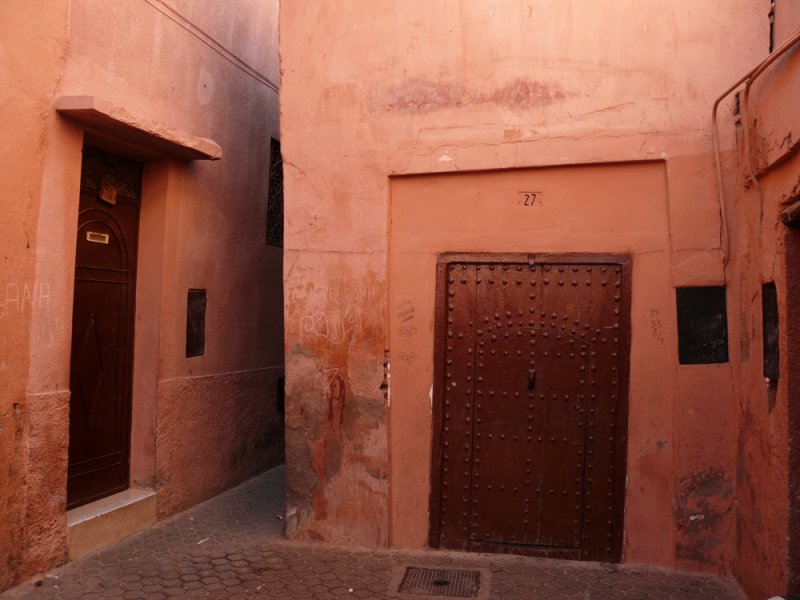
Tilted doors, Marrakesh, Morocco, 2006
Some of the structures in Marrakesh's ancient medina have settled over the years, tilting the frames surrounding the doors. The buildings themselves seem to lean a bit as well. This image uses doors to incongruously tell the story of an aging city. They will never demolish these buildings. They are what people come from all corners of the earth to see. If they did rebuild, they would probably make sure the new doors were tilted just as much as these are.