01-OCT-2018
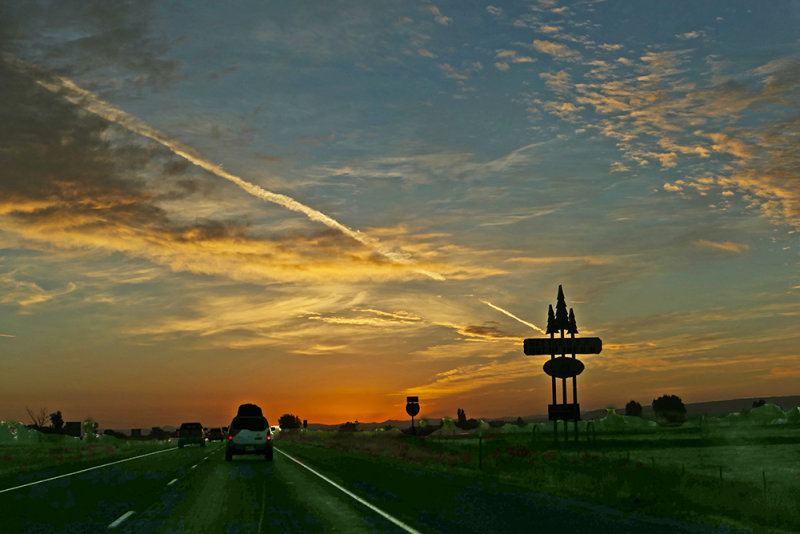
On the move by land and air, near Pocatello, Idaho, 2018
It's very difficult to carefully compose a photograph from the passenger's seat of an automobile moving at 80 miles per hour. In this case, however, I had an idea in mind well before the moment of exposure. A rising sun had been creeping towards the horizon,signalling the coming of dawn. Meanwhile, the sky overhead featured a huge jet contrail. I noticed that the white lines on the highway echoed the diagonal thrust of that contrail. I hoped to connect thie contrail, and the air traffic it symbolized, to the road traffic flowing ahead of us. I scanned the horizon, looking for an oncoming object that would provide a focal point to accomplish this. I spotted a large sign while it was far away. It kept getting larger as we approached. I waited until that sign and the contrail merged, and released the shutter. The road traffic flowing in front of us is abstracted --we see only a silhouette of a car. We don't see a plane in the sky, either, only a symbol of air traffic. My composition expresses the point of the image itself: the flow of moving traffic on ground and in the air.
06-JUL-2015
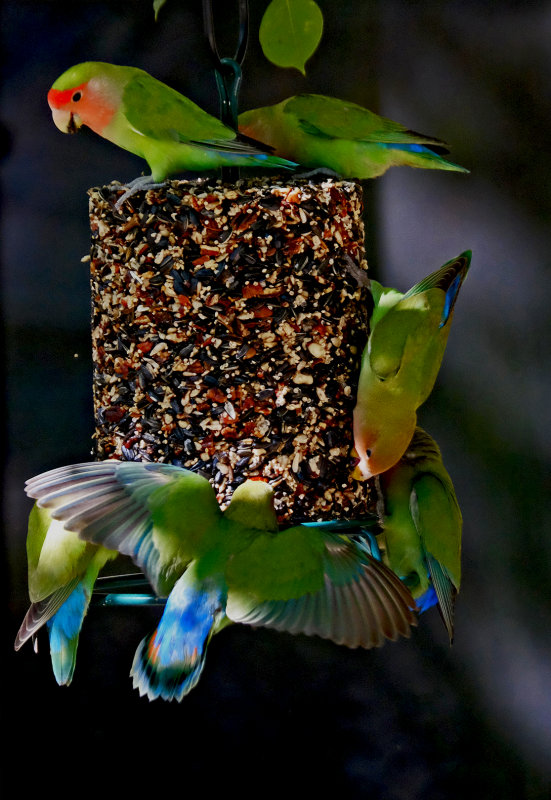
At the block, Phoenix, Arizona, 2015
I photographed these Rosy-Faced Lovebirds feeding at a block hanging in front of neighboring house. They are descended from Lovebirds originally imported from Africa by Phoenix pet dealers. There are now over 1,000 feral lovebirds in Phoenix. In this case, I allowed the feeding birds to compose the image for me. The pair of birds sitting at the time of the block were already in place, and so were the three birds clinging to its sides. I needed another bird in flight to enter the dark space at the bottom of the picture to bring action and bold new color into the image. I only had to wait for the right moment, and it happened. Its spreading wings contrast to the folded wings of the other birds, and the bold blue tail added a fourth vivid color to the composition.
13-FEB-2015
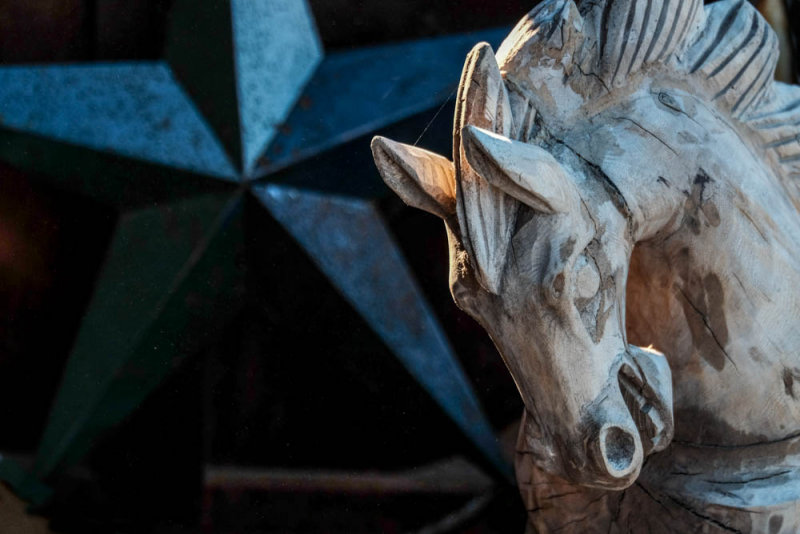
Rocking horse, Cave Creek, Arizona, 2015
I found this rocking horse just outside of a craft shop. I was drawn to it by the both the lighting and the background. I composed the image by gradually shifting my vantage point so that the horse’s illuminated ear points directly at a softly focused metallic star in the background. The diagonal thrust of the ear echoes the diagonal thrust of the star points, and links the energetic, bowed horses head to the dynamic force of the star.
08-FEB-2013
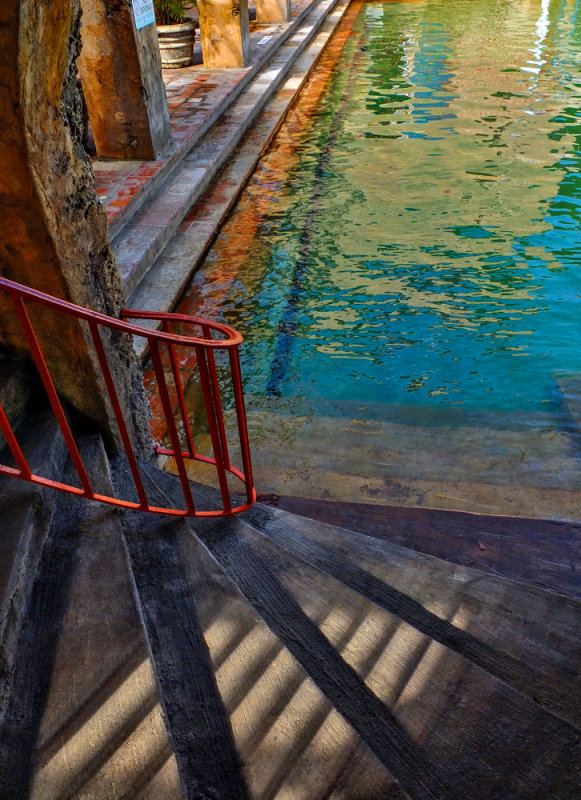
The Venetian Pool, Coral Gables, Florida, 2013
This historic pool, built in 1923 within a coral rock quarry, holds 820,000 gallons of spring water fed from an underground aquifer. During the spring and summer seasons, the pool is filled and drained daily. The Mediterranean design and coloration of the pool is exquisite, and my composition attempts to express the era and style in which it was built. I anchored the image upon the curving staircase that descends from one of its huge lookout towers. The repeating play of light and shadows upon the curving steps echo the play of light and shadow on the curving red railing just above them. Four entry steps – some above the water and others underwater -- emerge from the diagonal thrust of the pool’s edge that carries the eye from the stair railing all the way to the top of the frame. Meanwhile, the shimmering reflection of the pool’s second lookout tower rides the surface of the pool’s deep blue water.
10-JAN-2013
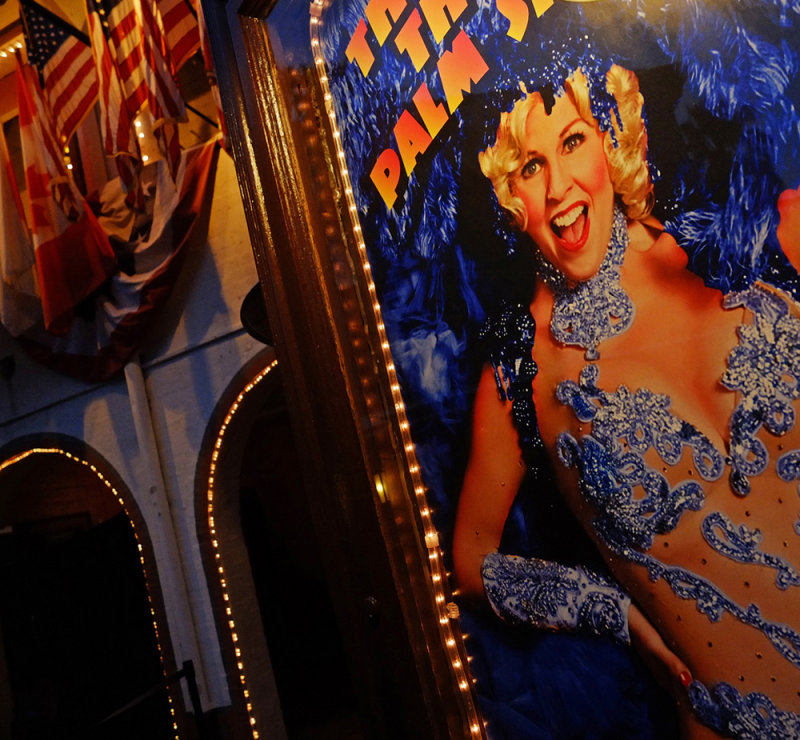
Plaza Theatre, Palm Springs, California, 2013
This theatre opened here 76 years ago, and is still going strong. Once home to radio broadcasts featuring the likes of Jack Benny, Bob Hope, and Bing Crosby, it now features a vaudeville show known as the “Fabulous Palm Springs Follies,” starring performers ranging in age from 54 to 83. Here’s how I composed this image: I moved in on a poster placed outside the theatre, tilting my camera slightly to make the visible part of the poster’s frame into a dynamic diagonal running through the center of the image. This emphatic image structure invites a comparison between the enthusiastic image of a performer on the right, and the curving lights over the theatre’s doors, as well as the massed bunting and flags above them on the left. Those flags hang from diagonal poles, while the arm and costume of the performer echo those diagonals. Finally, the placement of the flags, arm, and costume pull the eye of the viewer diagonally through the image from corner to corner.
09-MAY-2011
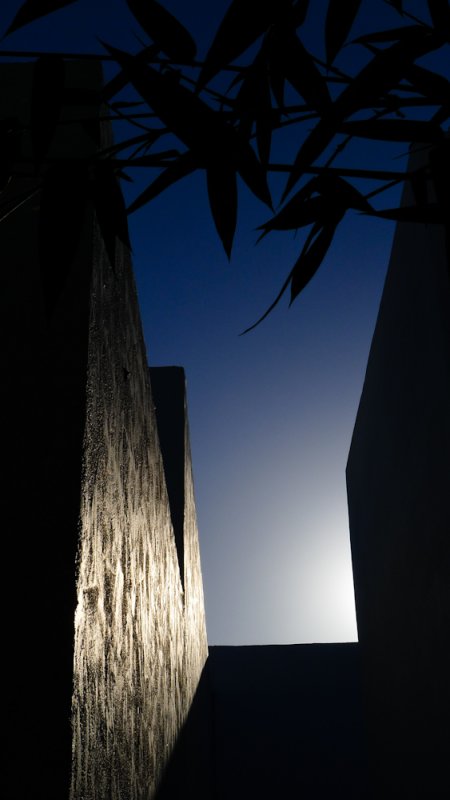
Hotel, Scottsdale, Arizona, 2011
I used my spot metering mode on the reflected late afternoon sun as it illuminated the rough texture of the wall at left. That reflection on the texture becomes the focal point of this image. I allowed all else to fall into silhouette here. The walls on either side are drawn together by the repeating diagonals -- the shadow at lower left and the slope of the building at upper right. I introduced the silhouetted leaves at top to draw the eye into the picture from the top, while the deep blue sky adds a striking backdrop to this geometric composition.
01-JAN-2011
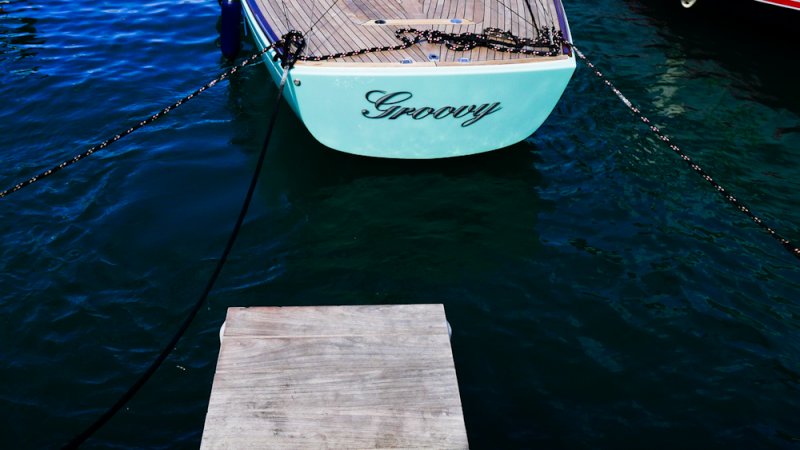
Groovy, St. Bart’s, French West Indies, 2010
I used my frame to abstract this small boat, moored among the huge yachts that lined St. Bart’s harbor, and incongruously named “Groovy.” I use the three ropes to create diagonal leading lines to draw the eye through the frame. I also truncate the pier that leads towards the boat and stops abruptly just short of its stern, creating an anchor for the image. The image’s focal point revolves around the space between the pier and boat, a gap that energizes the frame with tension.
12-NOV-2009
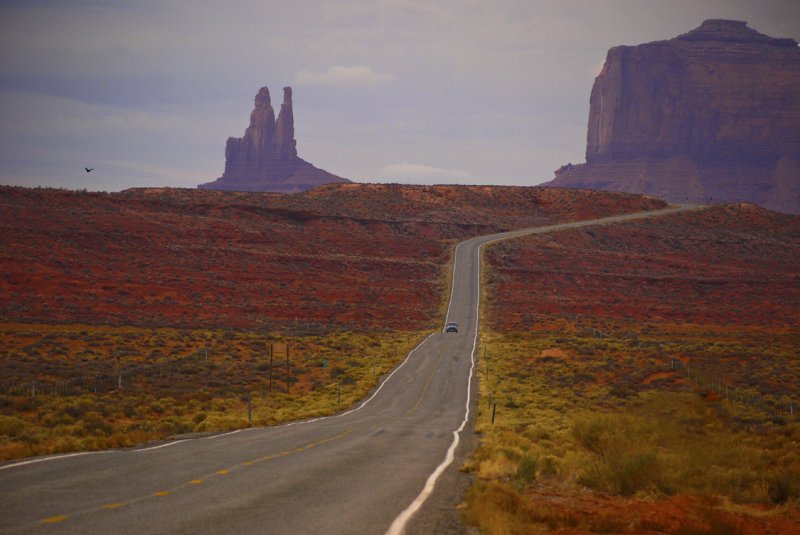
Monument Valley, Arizona, 2009
I structured this image as a diagonal composition, leading the eye into it by placing the base of the road at the lower left hand corner and letting it lead the eye into the dominant butte in the upper right hand corner. A car rolls through the midpoint of the image, defining the function of the road that splits a rich red desert landscape in half. A large bird in flight, and the twin spires of one of Monument Valley’s signature red rock monoliths add additional identity. If you move back from this image and view it from several feet away, these details become subservient to the powerful thrust of the composition itself. (I photographed this same road and landmarks, but in an entirely different way, a few day’s later. ( See
http://www.pbase.com/pnd1/image/119661839 )
19-OCT-2009
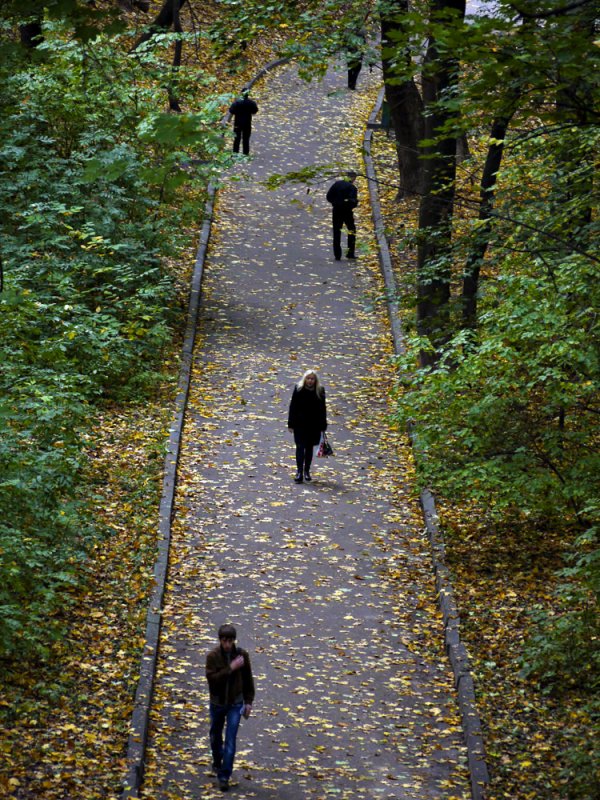
Autumn in the park, Kiev, Ukraine, 2009
I stood on a high hill overlooking the leaf strewn walk below and waited as strollers entered and left the frame. In my mind as I composed this image was the use of negative space. I wanted to anchor the image with a person at the bottom, and then space others evenly as the image fades into the background. The very last person is half hidden below a branch of leaves but his presence is critical. He completes a series of four evenly matched slots of negative space that lead the eye through the image and echo the gradual pace of a walk in the park.
24-JUN-2009
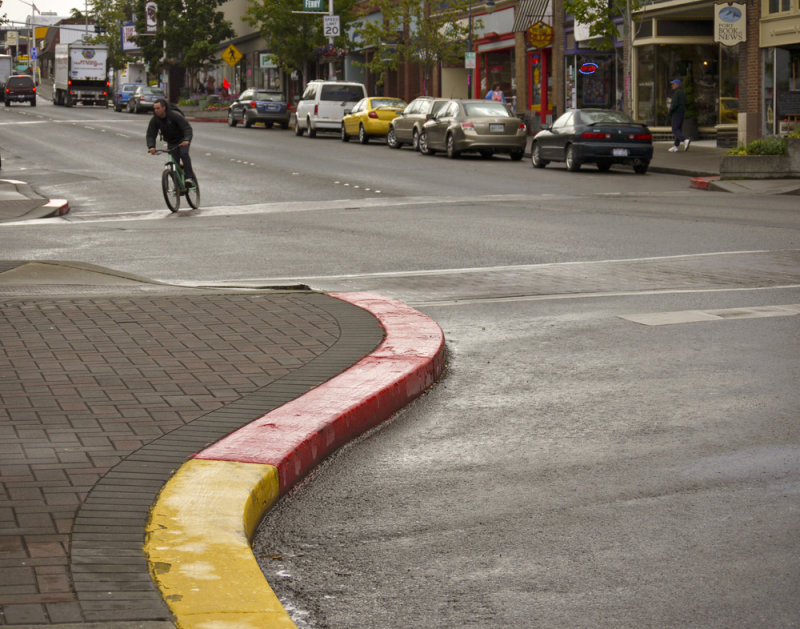
Cyclist, Port Angeles, Washington, 2009
The “S-Curve” is often seen in photographic compositions, a device that best serves the eye by leading it into or through an image. I found this s-curve first, and was determined to build an image around it. The curving parking cutout is painted in primary colors, giving it even more of an “eye-pulling” effect. I positioned myself over the yellow portion and waited for someone to become my subject by crossing at the intersection. My first attempts failed – too many cars cluttered the intersection while people were crossing with the light. After about five minutes of futility, I saw this cyclist heading towards the intersection. Even better, there was a simultaneous break in the traffic flow, giving me an uncluttered shot at him. I put my camera on burst shooting, and followed his progress with shot after shot as he approached. I had hoped to line him up with the red curbing as he passed me, but he decided to give me an even better shot by turning right into it and bringing the yellow and red s-curve to life. This image captured his lean perfectly as he flows through the upper left hand portion of my frame.
20-JUN-2009
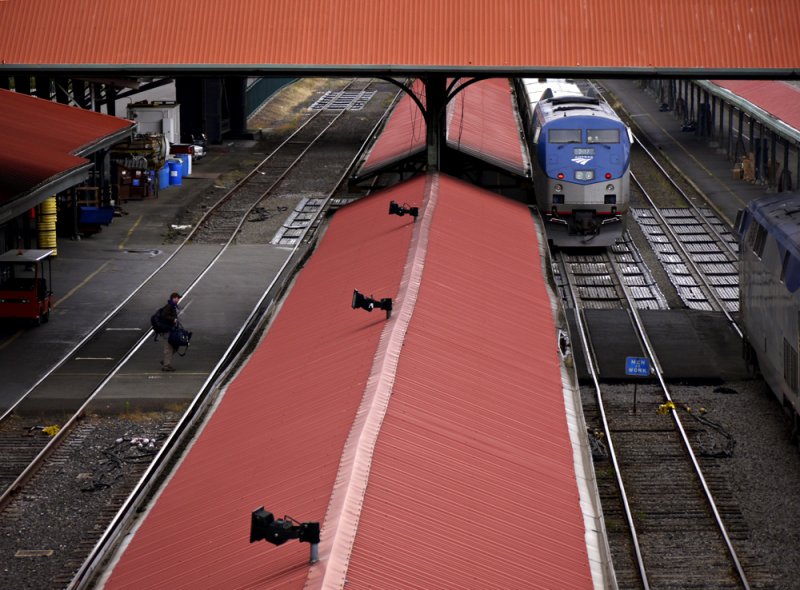
Amtrak Station, Portland, Oregon, 2009
The pedestrian bridge over the rails offered me an ideal vantage point from which to compose this image. The first thing I noticed was the dominant reddish pattern of rooftops that bisected the railyard. I moved to a point on the bridge that allowed me to divide my frame with the two vertical roofs, and then add a top to the “T” by blending the horizontal roof into the top of my frame. Tracks on both sides of the image echo the vertical flow of the center roofs, while a waiting train adds important context in the upper right corner. All I needed was a figure moving towards the train, and after a few minutes of waiting, one of the last passengers to board emerged from the station and crossed the track at left center. He is heading towards the dark opening between the two vertical roofs. I caught him in mid-step, and he becomes the focal point of my image.
02-JUN-2009
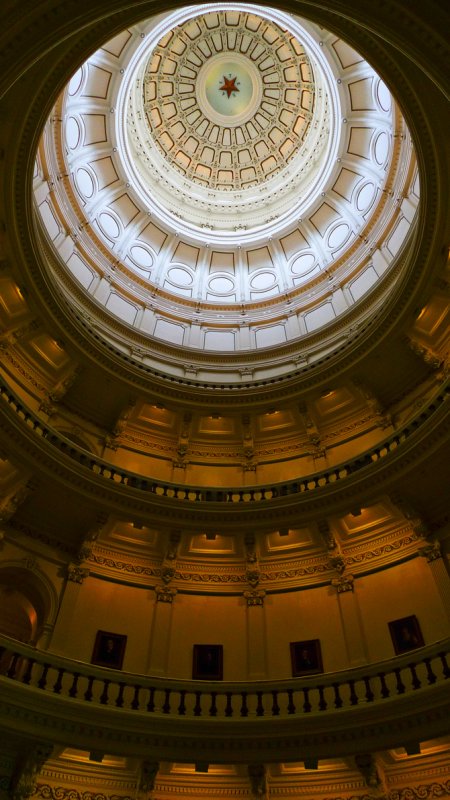
Rotunda, Texas State Capitol, Austin, Texas, 2009
A single star sends a series of decorative rays and circles spinning towards us as we look up into the interior of a dome that soars higher than the United States Capitol. These rays and circles lead the eye down to a series of circular galleries that mark each floor of the 120-year-old Texas State Capitol building. By limiting the scene to the vertical frame of a 24mm wideangle lens, I am able to compress the energy of the circular patterns into a narrow channel that leads the eye all the way up to the lone star at the center of the dome -- the focal point of the entire image. Organized by concentric circles and partial circles, the image guides the eye through the scene. Meanwhile, the color temperature changes from the palette from gold in the lower galleries, illuminated by electricity, to the white light playing on the dome’s interior, illuminated by the window light.