11-JUN-2009
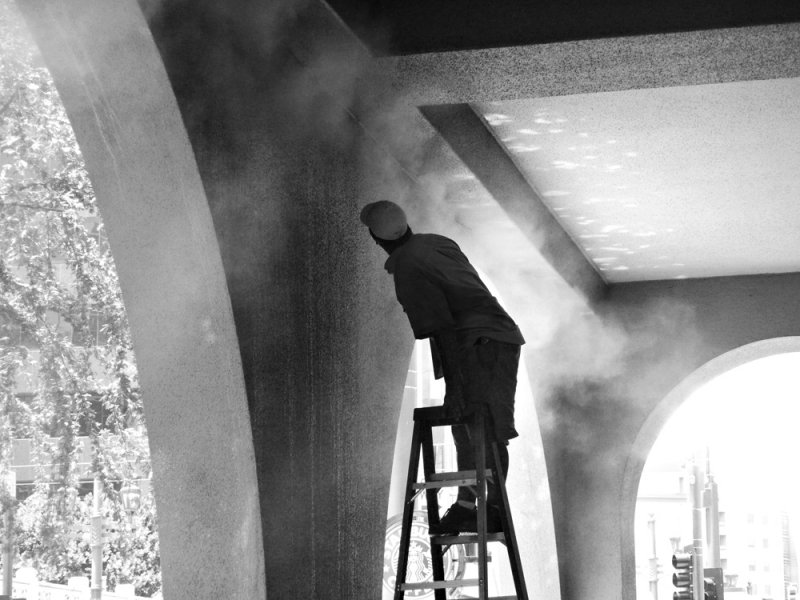
Misters, Phoenix, Arizona, 2009
When the thermometer hits 100 degrees or more in Phoenix, residents appreciate the misting systems that send clouds of cooling water droplets into the air. This fellow is adjusting a misting system in an arcade outside the entrance to a downtown Phoenix hotel. I had to increase my exposure to accommodate the deep shadows under the arcade, which meant that everything outside the arches of the arcade would be over-exposed. I rarely will deliberately over expose a photograph, but in this case, the over exposure works as expression. The clutter beyond the arches vanishes in a haze of white heat, making the mist that oozes from the ceiling of the arcade seem even cooler. Black and white was the logical choice for such an image. It removes distracting traces of color in the over-exposed areas, and underscores the presence of both the heat and the cooling wet mist.
01-JUN-2009
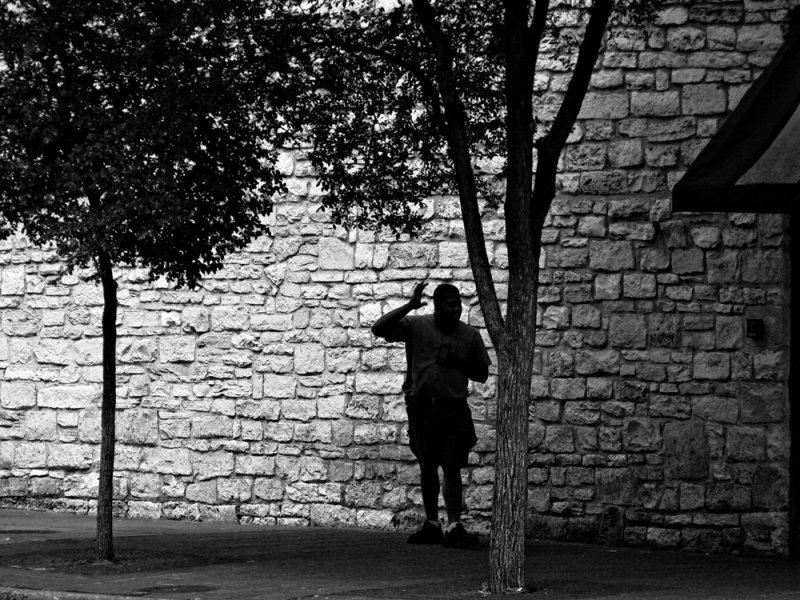
Farewell, Austin, Texas, 2009
I saw this man talking with someone just outside of my frame, and as he raised his arm to say goodbye, I noticed how the diagonal line of his arm echoed the thrusting diagonal limbs of the tree next to him, as well as the diagonal roof line of a building canopy at right. I exposed for the light on the wall, throwing the subject into a silhouetted abstraction. Since there was no color in the image, I converted it to black and white, further abstracting the scene.
15-APR-2009
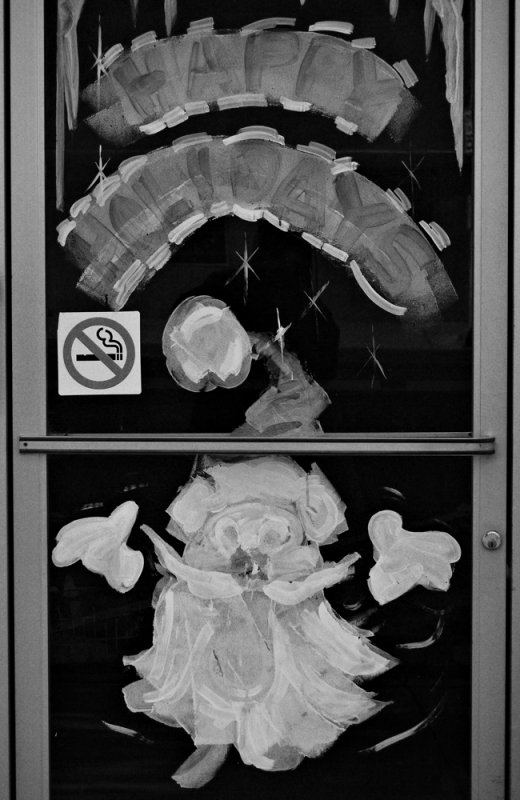
Happy Holidays, Kingman, Arizona, 2009
This is the door of a toy shop that shut down just after the Christmas shopping season. Someone has used paint to cover the once cheerful slogan and a gesturing Santa. I converted the image to black and white to abstract it and make it more symbolic of a grim situation. The no-smoking symbol remains as well – its red circle now gray. It becomes a symbol that, for the time being at least, has lost its function.
20-MAR-2009
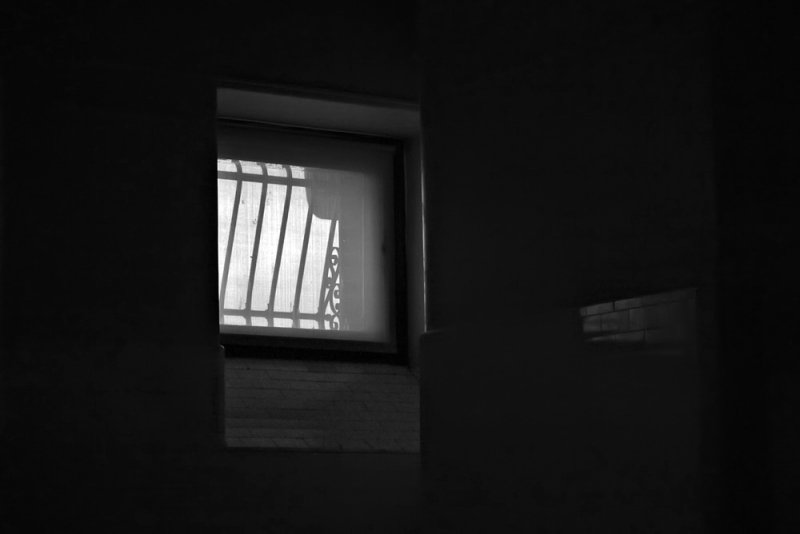
Window, Ellis Island Immigration Station, New York City, New York, 2009
From 1892 until 1924, more than 12 million immigrants entered the United States through Ellis Island. Today, its ornate Victorian buildings stand as a museum and memorial in New York harbor, in the shadow of the nearby Statue of Liberty. Many of the rooms in Ellis Island’s main building have been restored to their original appearance, including this one. I exposed on the window light to darken the room, and converted the image to black and white to strengthen the sense of what it must have felt like to pass through such a room more than 100 years ago. New York City was so close – the end of a long and often anxious journey. Yet the ornate bars on the window, the harshness of the dimly seen tiled wall and ledge, and the confining cloak of darkness must have made a new home seem, at least for the moment, out of reach. For some immigrants, the bars symbolized the threat of denied entry. For most, they were simply a final barrier to the promised land.
09-NOV-2008
Checkerboard cat, Kairouan, Tunisia, 2008
As I walked through the medina of Kairouan, a black cat ran across the street in front of me. While the superstitious might fear bad luck, the cat brought good fortune to me, because it was bound for a street corner appropriately paved in black and white checkerboard tiles. It even turned its head towards me as I focused my camera on it. I originally made this image in color, but the only other color in the photo, aside from the monochromatic pattern and cat, was the dingy gray color of the concrete curb, pavement, and wall. When I converted the image to black and white, the checkerboard pattern becomes even more dominant, providing the black cat with a fitting context.
06-NOV-2008
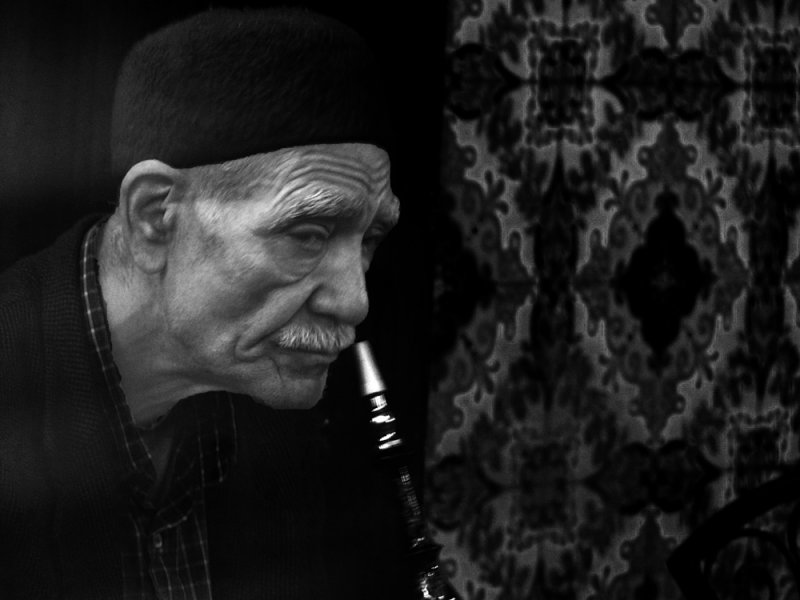
Morning smoke, Tunis, Tunisia, 2008
This man is smoking a hookah, a water pipe called a Chicha in Tunisia. The pipes are used to smoke tobacco in cafes, and are provided free. The smoker pays only for the tobacco. Chicha smoking is usually a group activity, but this man was smoking one by himself. By zooming in on his face and converting the color image to black and white, I try to reveal more character and heighten his reflective mood. (You can see a color image of this same smoker in my portrait gallery, at
http://www.pbase.com/pnd1/image/106455730 . The red hat and the colors of the wallpaper behind him express an entirely different mood.)
06-NOV-2008
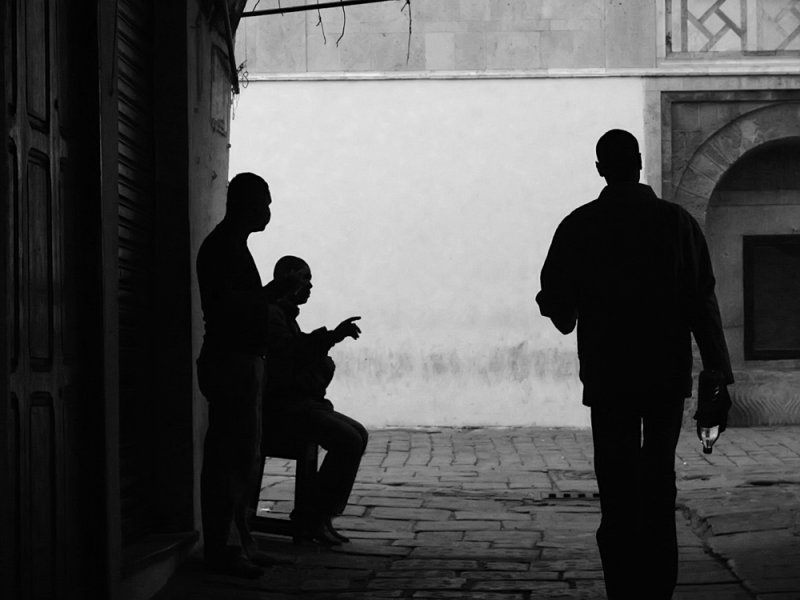
A beckoning, Tunis, Tunisia, 2008
The Tunis medina, a labyrinth of twisting narrow streets lined with shops, mosques, cafes and workshops, is over 800 years old. It is a place of many stories. I tell one here in this image of a silhouetted man beckoning to another. Perhaps he is calling to a friend, or maybe he is hoping for a sale. We will never know, but I hope this abstracted black and white image will allow the imagination to fill in the blanks.
16-NOV-2008
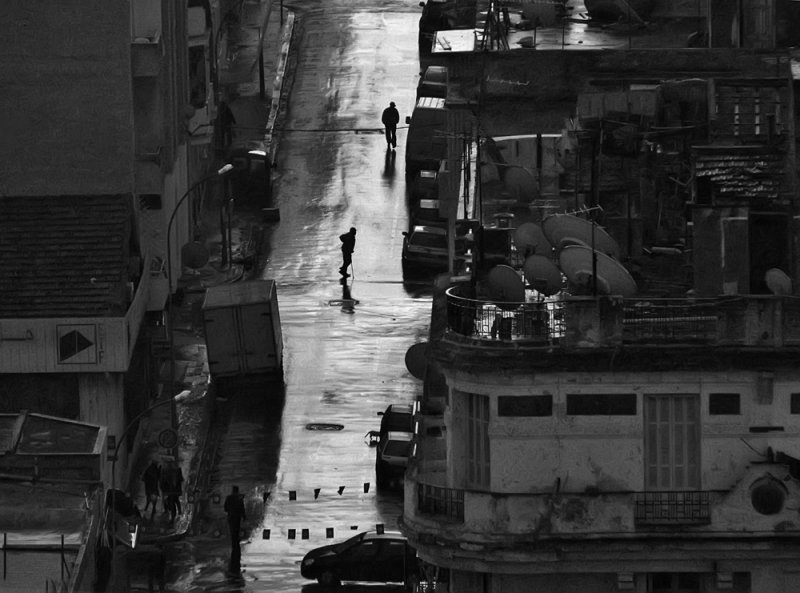
After the storm, Tunis, Tunisia, 2008
On my last day in Tunisia, I was driven from street shooting in Tunis by a sudden rainsquall, the only rain I saw during my two-week journey. I watched the rain lash the city through the window of my 15th story hotel room. As it ebbed, Tunisians began to walk the wet, textured streets and I photographed them from above. I counted at least seven in this image. The black and white conversion further abstracts their silhouetted shapes, making them symbolic figures awash amidst a sea of aging buildings, their rooftops bulging with satellite dishes.
11-OCT-2008
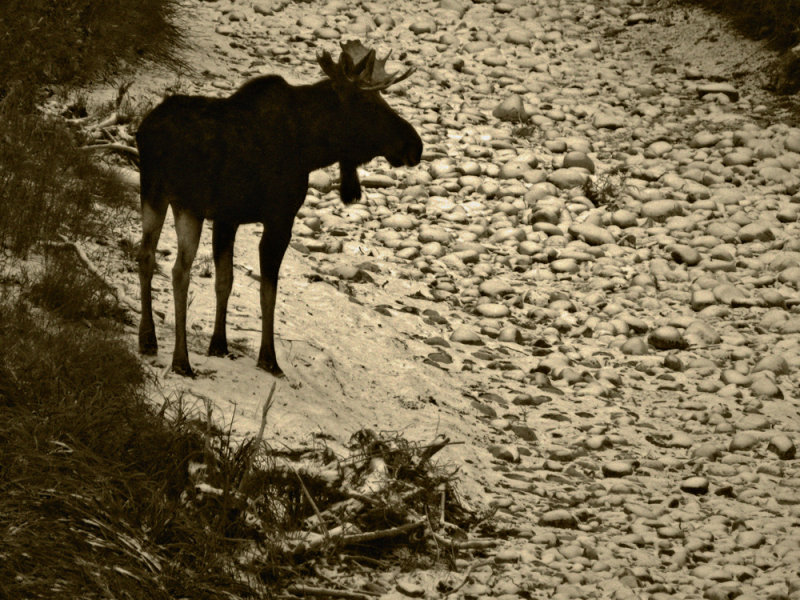
Bull Moose in sepia, Grand Teton National Park, Wyoming, 2008
Sepia tone is a variant of black and white imagery – it is nearly as monochromatic, only its tint can add symbolic meaning. This is the same Bull Moose that I photographed on the chase in the subsequent image. An hour earlier, I found it surveying a dry wash running along side of the Snake River. By converting the image from color to black and white and then applying a sepia tone, I made this image even more symbolic and timeless in nature. It could have been made a century ago. The moose becomes master of all it surveys here – a universe of ancient rock. I use sepia tones very sparingly, almost always to add the patina of age to an image.
11-OCT-2008
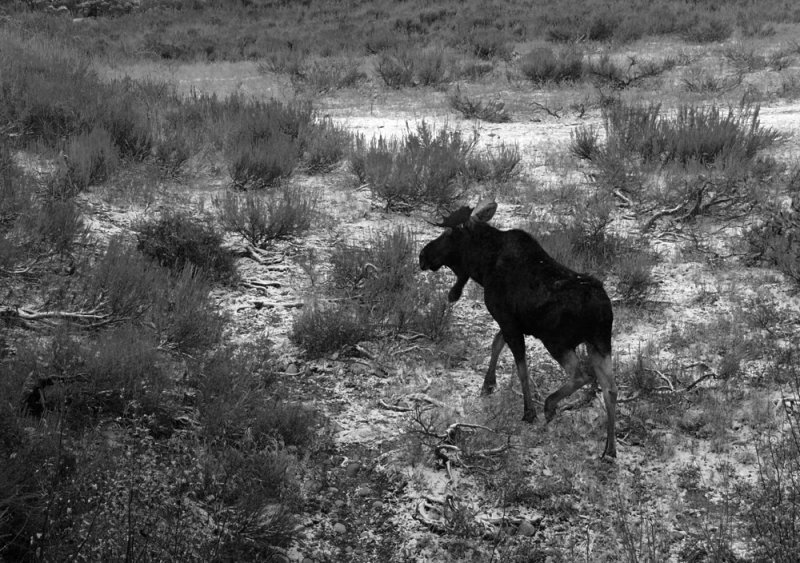
Bull Moose on the chase, Grand Teton National Park, Wyoming, 2008
This Bull Moose was chasing a calf away from his breakfast area along the
Snake River. It was quite angry and moved out from just below the bridge on which I was standing. In color, this image was awash in early morning light – a scene too pretty for the grimly determined attitude of the moose. I removed the competing colors by converting the image to black and white.
16-SEP-2008
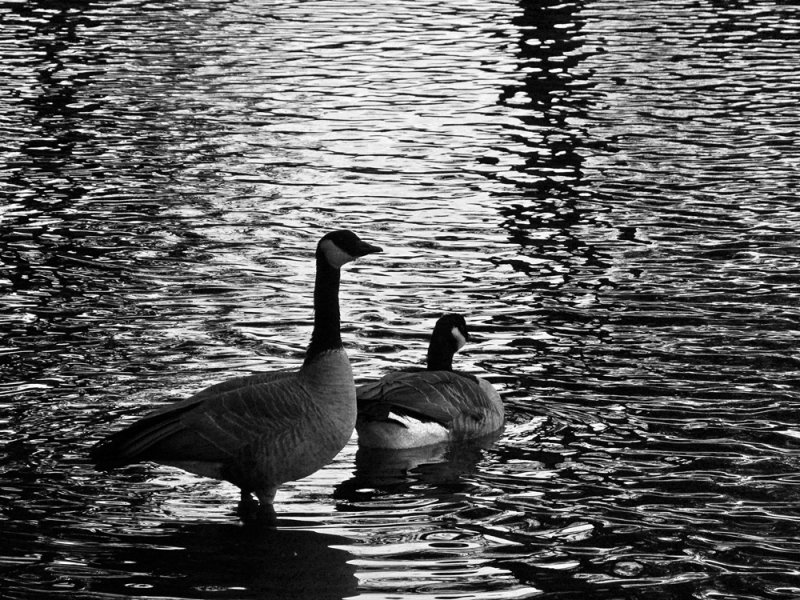
Canada Geese, Drake Park, Bend, Oregon, 2008
The rippling texture of this image drew me to the scene – the image would not have worked as well had the river been smooth. The ripples are backlit by the evening light, which create the texture. I tried the image first in color, but the greenish water competed with the beauty of the rippling textures. The geese are abstracted by backlight as well, and since they are black and white birds, they work beautifully in a black and white photograph.
01-SEP-2008
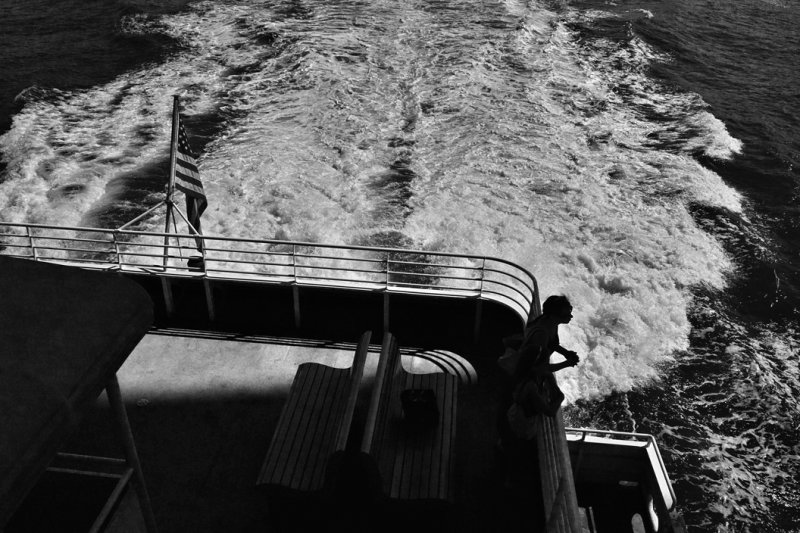
On the East River, New York City, New York, 2008
I use here the dual abstraction of black and white, along with a silhouette created by backlighting, to isolate an individual in light, time, and space, and make that person into a symbol speaking of introspection. I made this image from the upper deck of a tourist boat that carries sightseers around Manhattan Island. In the color version, the deck of the boat was a greenish blue, creating a color emphasis that competed with the quiet mood I intended to convey in my image. The American flag hanging from the stern of the boat was far more evident in color as well – yet my image was not about national identity. By converting the image to black and white, I increase the degree of abstraction and eliminated the competing color elements from the image.