I got a call from a customer who felt his motor was running a little hot in the fall and thought he should address it during the off season. We decided to pop the caps off the heat exchanger, check it out, and take it from there.
I popped off the heat exchanger caps on a warm Maine early spring day.
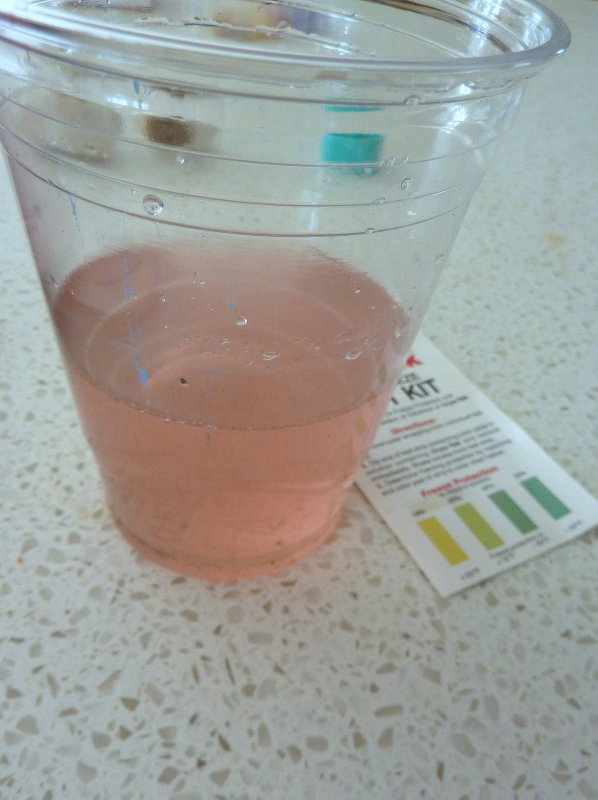
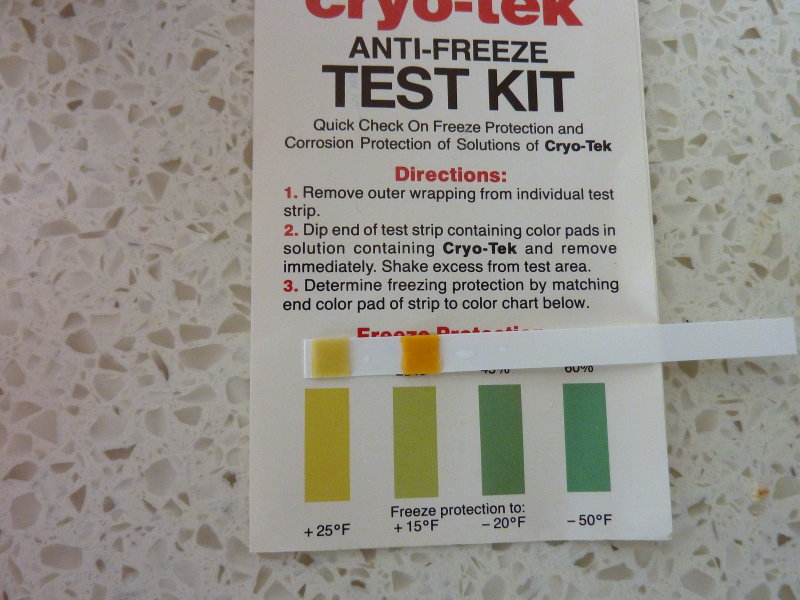
Noticing the very diluted color, of the propylene glycol, I took a cup of it home and tested it with my sight refractometer. The freeze point was around 25F on a test strip but the refractometer reading was actually worse than the test strips and is far more accurate.
I called the customer to inquire about the "winterizing" process. The owner had decided to undertake the winterizing himself in the fall, and claimed to have sucked 2 gallons of -50 RV antifreeze through the system.
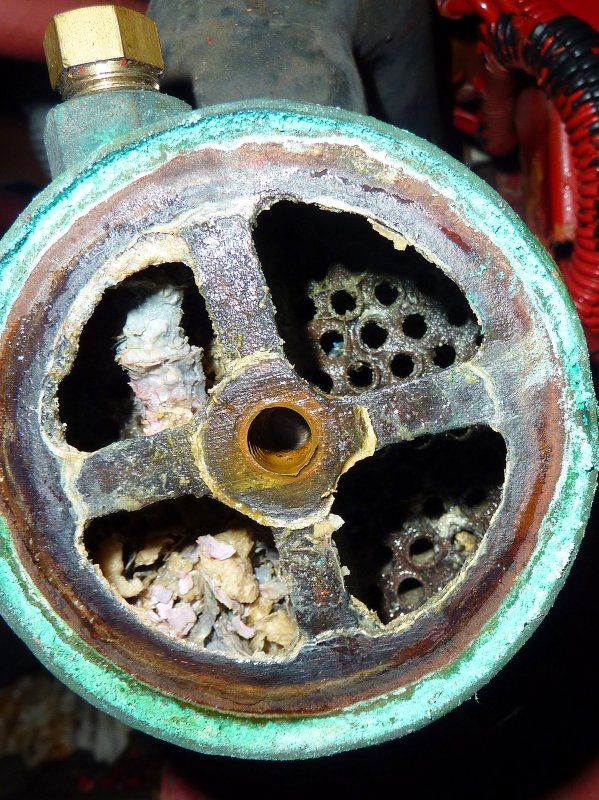
I now needed to pressure test this HX. After removal and pressure testing it was discovered the heat exchanger had frozen and split in the tube pack. The low temp that winter had been about -14F.. A repair like this costs a fair amount of money, and certainly far more than sucking in an extra gallon or two of antifreeze. Think about this the next time you decide to suck in "untill you see pink".... Westerbeke, the maker of this engine, suggests an entire 5 gallon bucket!!
RV antifreeze/propylene glycol is not intended to be diluted and should be used full strength. When diluted the freeze and burst points rise rapidly, because it is already diluted from the factory..
When in doubt suck in another couple of gallons or test it!!
15-APR-2011
Testing the Propylene Glycol
Test strips are not my first choice in testing PG antifreeze concentration, but they are ok and can work. I used these test strips for illustration purposes because photographing through a sight refractometer is nearly impossible.
You can not effectively test PG antifreeze with an ethylene glycol tester. A sight refractometer is the best method but they are pricey. The good thing about a sight refractometer is they are also very, very accurate for testing the specific gravity of a battery so you kill two birds with one stone by owning one.
I often hear; "I just look for pink out the stern and shut her down."
While it may "show up", and you may "see pink", what is it's concentration before and after? What is the burst point? What is the freeze point? You may see pink but this does not necessarily mean you are protected against freeze damage for a real cold snap.
Water flow through a strainer, hoses, HX and water lift muffler is not simple complete displacement event. What you pump in gets mixed & diluted with whats already in there. -50F or -60F Propylene glycol should not get diluted or you will drastically raise your freeze and burst points. The -50 products are already heavily diluted and -50 is the burst point for metals not the freeze point.
The burst points for plastic are usually about 30F higher than for metals. Today many vessels ship with plastic sea strainers.
Add just a little water, through dilution, and your burst point raises very quickly to ranges we see up North in a regular winter.
I once watched a strainer while sucking in 5 gallons. The bottom of the strainer was still clear water at 3 gallons and by five gallons it was full purple. And this was at the intake strainer.
I know from testing that it takes a minimum of five gallons through our 44HP engine and RW circuit to get the same burst points out the stern as what it went in as. I also pre-drain the strainer which holds about 32 oz. The only way to know your burst point is to physically test what comes out or simply suck more in for added insurance.
Some engines will take less and some take considerably more. I depends a lot on the internal flow characteristics of your engine. We see plenty of freeze problems up North from too little AF used or improper winterizing techniques.
At $3.99 a gallon it can be a lot less expensive than freezing your strainer, raw water pump or heat exchanger.. Invest in a test kit then you'll know exactly how much your motor takes.
How do I test?
The absolute easiest method is to use a sight refractometer. These can also be used for testing the specific gravity of a flooded battery (actually my preferred tool for SG readings). The best way to use a refractometer is to take a baseline sample of the AF you are going to use. Look through the sight glass and read it. This is your baseline number. Now suck in one gallon of AF and capture a sample in a cup out the exhaust. Compare it to the baseline reading. Does it match?
What comes out the exhaust should match perfectly what went in. If you need more suck in another gallon and test again. Once you have hit your match, same in as out, you know exactly how much your engine takes to be adequately protected.
Every spring I deal with frozen and split heat exchangers, water heaters, valves etc. all from owners allowing the concentration to become far too diluted.
NOTE: Winterizing raw water cooled engines very often requires the removal of the thermostat for effective freeze protection. If unsure consult someone who knows your engine well.
12-APR-2011
Found The Problem
The good news is this owner now has a new heat exchanger. The bad news is it cost him a lot more than a couple of extra gallons of antifreeze would have...!.
I also found the cause of his cooling issues, zinc crud. Change your engine zincs often or they can shed and plug your HX.
19-OCT-2015
"See Pink & Shut Her Down".....
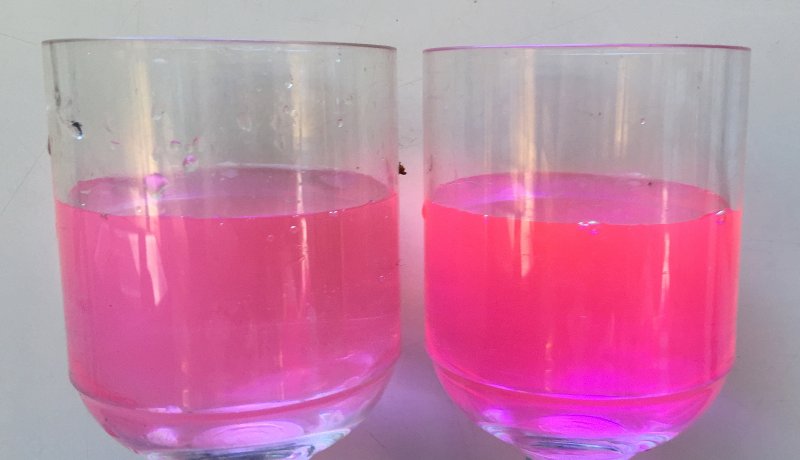
These samples are from a Grand Banks trawler at 8 gallons sucked through the raw water system. To the naked eye you would be hard pressed to tell the difference between these two samples as they shot out the exhaust.
The sample on the left was taken at the end of gallon 8 and the sample on the right is straight out of the bottle. Raw water pumps, strainers, oil coolers, gear coolers, heat exchangers, water lift mufflers and refrigeration coolers are expensive. Propylene glycol is cheap...
19-OCT-2015
"Seeing Pink" is NOT Enough!
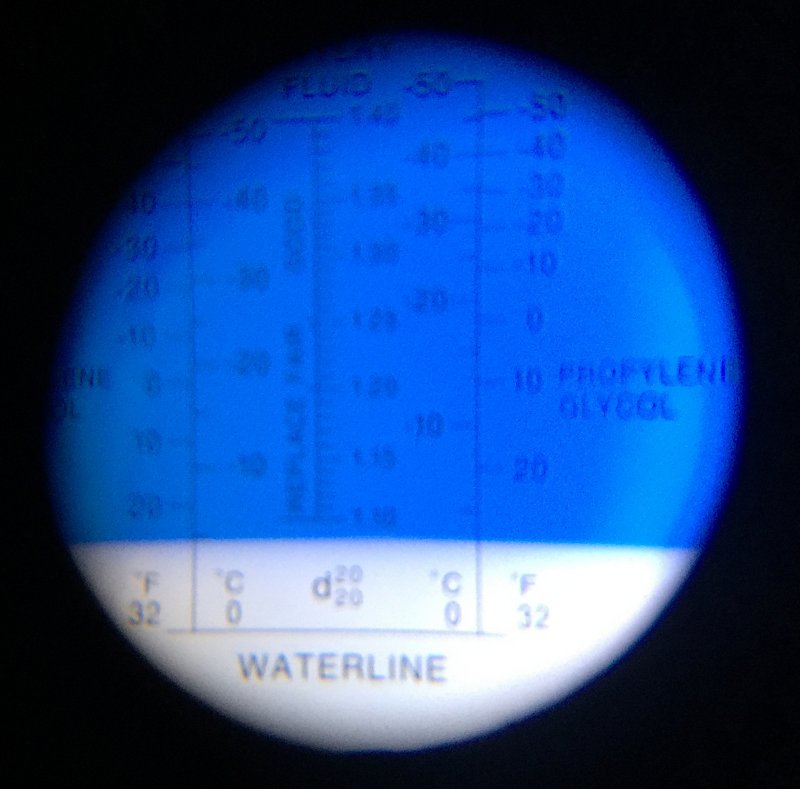
Sorry for the bad photo taking a picture through a refractometer is extremely difficult but it tells the "rest of the story". I actually used my iPhone to snap this shot but it was still impossible to get a crisp photo. This was the best of about 30 shots of the same reading....
Out of the bottle this product measures about 4F on the refractometer. The goal is to match the bottles refractometer measurement/reading with what is coming out the exhaust. Please understand that PG will ice up/slush up well before it ever bursts. Most -50F rated PG products will turn to slush at around 0F to 10F. For proper burst protection it is critically important to NOT dilute it because the burst point raises rather dramatically when diluted more than what the bottle already is.
In this sample, taken at 8 gallons, the freeze/slush point is around 27F indicating a strongly diluted sample. It should read 4F just as it came out of the bottle.
28-MAR-2014
Don't Forget The Ethylene Glycol
Over the years I have come across many engines that were very diluted on the ethylene glycol side. heat exchanger leaks etc. can cause this as can an owner adding only water when or if the EG level gets low.
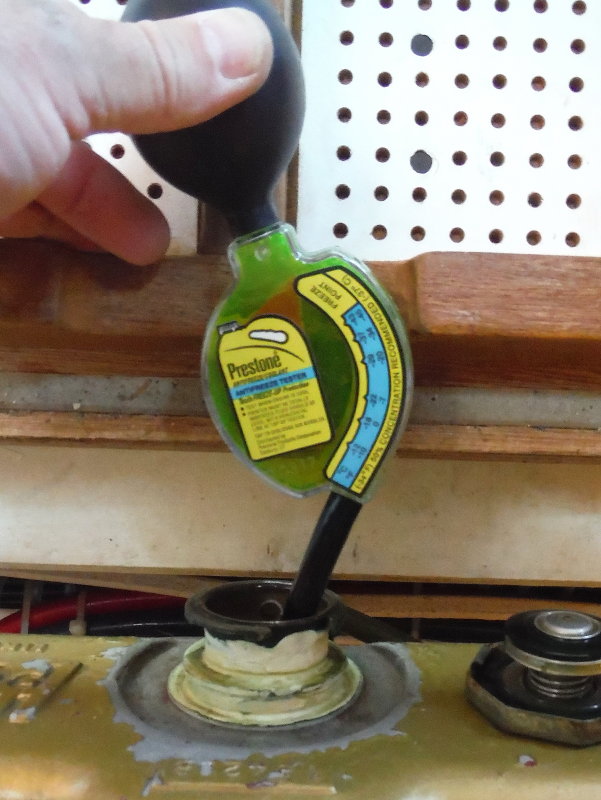
Before winter be sure to test the ethylene glycol side of the cooling system. No winterization of an engine is complete without this simple test.
The Prestone testers, like shown, are dirt cheap and work satisfactorily for ethylene glycol (Prestone/Peak/Dex Cool type antifreeze). They can not however be used for propylene glycol.
Happy Boating!!
MAY-2006
Help Support This Site
Like what you saw or read in this article? Was it helpful? Could the information save you some money? Would you like to see more articles like this?
If so feel free to donate, support the site, and keep it growing. Please DO NOT feel obligated at all. If you like it and want to make a donation, please do. Your donations help keep the content coming and also help keep it FREE.
Click the DONATE button below if you would like to make a donation via PayPal.