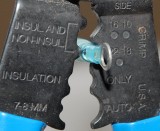
In this photo I have placed a heat shrink terminal into the jaws of a Klein dimple or staking crimper. It certainly does not take a rocket scientist to understand why a dimple crimper should be avoided for use on a heat shrinkable terminal. Once you squeeze the grip the dimple can puncture the expensive protective heat shrink insulation thus rendering the protection you paid for virtually pointless.
NOTE: This Klein cut-strip-crimp tool shows a spot for insulated crimps and also says insulated & non-insulated for the dimple crimp nests. I can not, with a good conscience, recommend anyone using this particular tool, or any crimp tool like this, on heat shrink insulated terminal.
Using a one size fits all, crimp tool will usually not save you any money in the long run.
IMPORTANT: If and when you do use a dimple/staking crimp tool the dimple is ALWAYS MADE OPPOSITE THE SEAM. Always face the seam AWAY from the dimple, not at it, as I have shown.
In this photo I am showing the orientation many folks often use, it is incorrect. Doing this can split the brazed seam and cause the termination to fail at a very low pull out strain. If you must use a dimple type tool the dimple should be be made opposite the seam.
Perhaps the most lacking feature of a dimple or staking crimper is that you lose any sort of strain relief crimping on standard insulated crimps. The entire load is taken by just the crimp barrel.
A double-crimp ratcheting tool is designed to make two crimps, one for strain relief, which has different sized dies, and one for the bare wire crimp. If you are trying to wire a boat to be ABYC compliant, which by the way is not a requirement for a DIY, a dimple or staking crimper would not qualify as the correct tool to use under E-11 for insulated terminals.