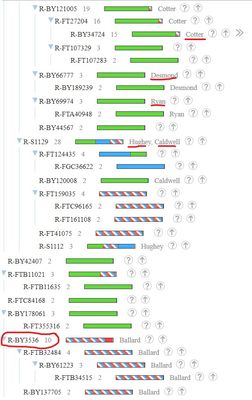
Ballard DNA Project FTDNA, Haplogroup R1b1a2a1a1b4 L21
Haplogroup R1b1a2a1a1b4 P312+ L21+ SNP - Deep Clade Test by Family Tree DNA (FTDNA)
Also Known as R1b1b2a1a2f L21+ http://en.wikipedia.org/wiki/Haplogroup_R1b_(Y-DNA)
Paleolithic Man: 30,000 BC
R1b probably arrived in Spain from the east among the peoples considered to be aboriginal to Europe. It is believed that everyone who is R1b is a descendant in the male line from an individual known as “the patriarch” since his descendants account for over 40% of all the chromosomes of Europe. This haplogroup is characteristic of the Basques people who are genetically the closest of the original R1b population of only a few thousand.
Source: Dr. David Faux http://www.davidkfaux.org/shetlandhaplogroupR1b
Altamira Cave, Northern Spain: 18,000 BC
Location: N43 22 57.1 W4 06 58.2 (Santillana del Mar, Spain)
During the Last Glacial Maximum, about 18,000 years ago, the people bearing the R1b haplogroup over wintered in Northern Spain. After the glacial retreat about 12,000 years before present, R1b began a migration to the north in large numbers and to the east in declining numbers. Source: Ken Nordtvedt http://home.comcast.net/~libpjr1/haplogroupI.htm
In 1879, the first cave with Stone Age paintings was discovered at Altamira in northern Spain. At the time, it almost defied belief that they were as ancient as we now know them to be, almost 15 000 years old. The influence of Darwinian Theory led scientists to believe that early man was ape-like and therefore incapable of mentally challenging or artistically creative acts. Thus the Altamira paintings were immediately declared to be fakes. Only after the discovery of more Stone Age caves, whose paintings could be dated on the basis of their relationship to the archaeological find, and further research, were they finally confirmed as originals. Source: Deutsches Museum
Link: http://en.wikipedia.org/wiki/Altamira_(cave) Link: http://www.showcaves.com/english/es/showcaves/Altamira.html
Atlantic Modal Haplotype (AMH):
Four sub-clades of R1b are derived from the repeats of DYS markers 390 and 391. The most common sub-clade is known as the Atlantic Modal Haplotype (AMH) with values of 24/11. The AMH is most common along the Atlantic coast from Spain to Scotland.
Anglo-Saxon Sub-Clade of R1b:
This sub-clade will have values of 23/11 at DYS markers 390 and 391. If one's known ancestry is in the British Isles and one has R1b of this sub-clade, the odds are tilted against that being an "indigenous" R1b and toward being a NW European continental R1b brought to the British Isles by one of the historic invader/immigrant groups from Brussels, Holland, NW Germany, and Denmark. This tilt should be incorporated into all the other surname and related information you have about origins of your R1b. This represents Anglo/Saxon England populations after the Roman occupation ended in 410 AD but before the Norman/Viking populations in the early 1000's AD.
Link: http://freepages.genealogy.rootsweb.com/~gallgaedhil/haplo_r1b_dys390_23_two.htm