21-FEB-2013
The first hint of nesting activity this year.
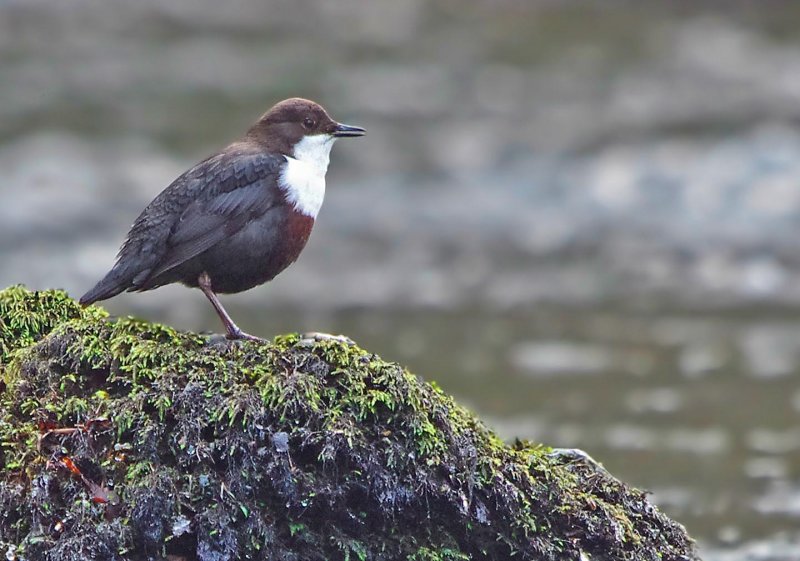
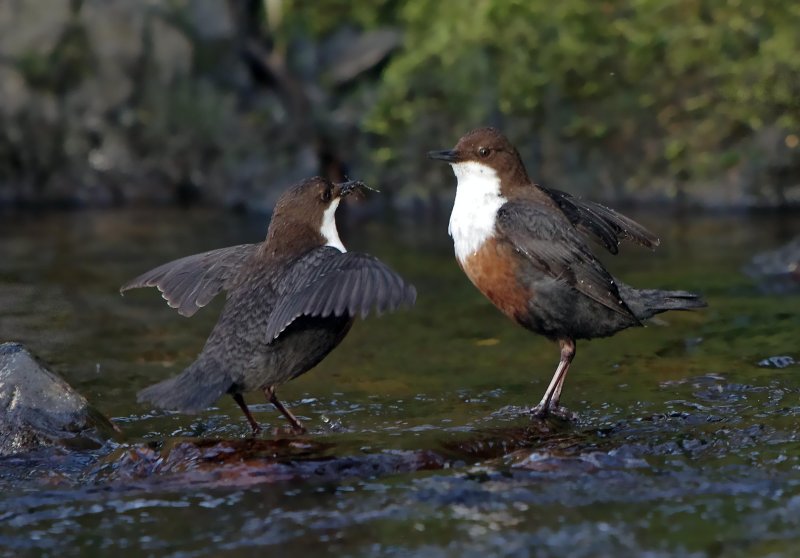
There was quite a lot of Dipper activity today. When I arrived on the river I saw a pair quite close to the start of my walk and they moved on down the river as I walked, keeping a safe distance ahead of me. I half expected them to double back as they would do if they were out of their territory but I was pleased when they carried on past the hide. This meant of course that this pair were the residents of the "hide stretch" of river. In it's self quite a discovery. I was pleased as I sat in the hide because I knew, based on my previous observations over 3 years, that they would have to fly back up to me before too long. There is another Dipper territory down river and they wouldn't stay there for long, and so it proved. It was about 15 minutes or so before they appeared to my right feeding with a lot of enthusiasm. Eventually one of the pair, I think the female came to the rocks exactly where she had been yesterday and I snapped away happily. It's good when you haven't had to wait too long. There was the slightest hint of a wing fluttering courtship display which would indicate that things are progressing along the right lines. They both retreated to the midstream boulder where I had seen them lots of times in previous years. Then suddenly, and this is very interesting, two Dippers flew past me very quickly and I thought they had gone for today. But I was wrong. I looked back to the rock and one bird still remained. I think what had happened was another Dipper had entered the territory and immediately been chased upstream by the dominant male. After everything had quietened I checked the old nest from two years ago. Amazingly and I am very pleased to report that there was brand new fresh moss in the bowl of the nest meaning of course that they have started to use this nest. This doesn't necessarily mean that they will continue to use this nest but it is great news and a massive step in the right direction.
20-FEB-2013
The first close encounter of the year.
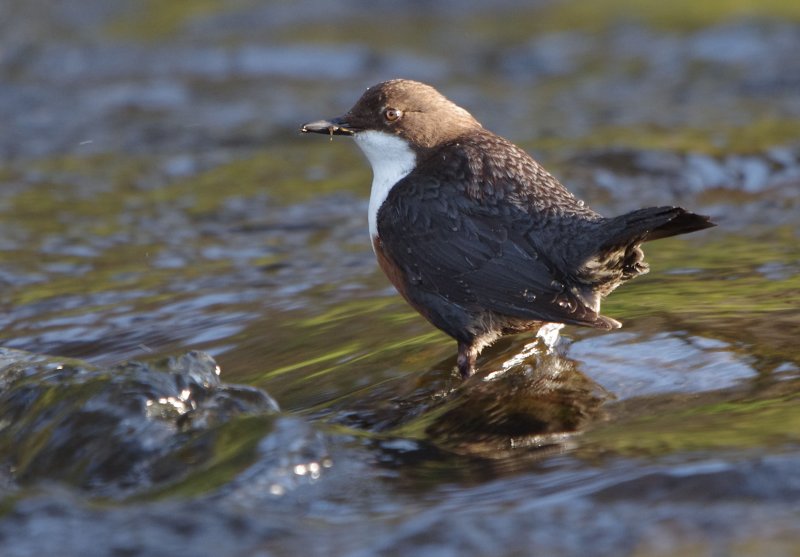
I had my first proper close-up Dipper encounter of the year today. If you read my Blog regularly you will know that I am a very patient, some would say obsessive photographer and I have already done around 10 hours in the little river side hide so far this February. I had been in the hide for 2 hours this morning and decided to come home at around 1 o'clock. At that point I had literally seen just one bird all day, a Grey Wagtail and that had just quickly flown by. I was bored and cold by now. I withdrew the protruding camera from the hide and was just about to climb out and leave, but remembering the other day when I had disturbed a Dipper as I exited, I quickly checked. Can you believe it, there was a Dipper just in front of me on the waterfall. I had been waiting for 2 hours plus and seen nothing and then just as I was leaving, now one was there. Unbelievable.
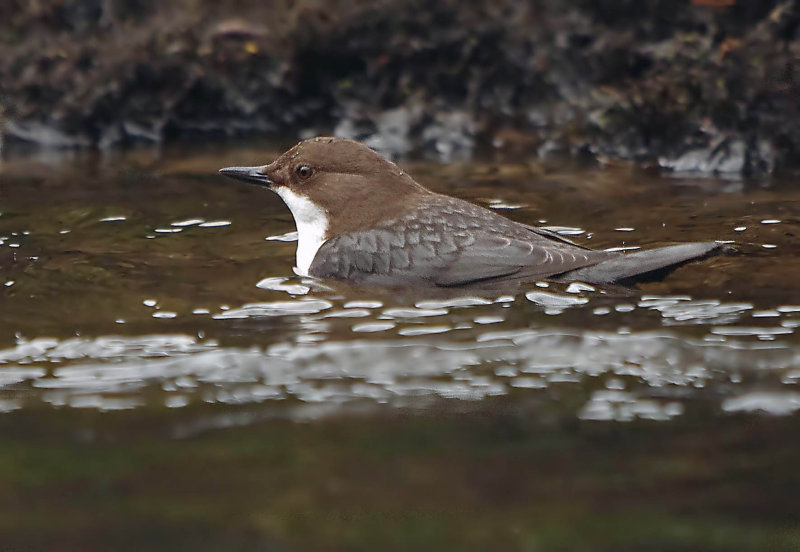
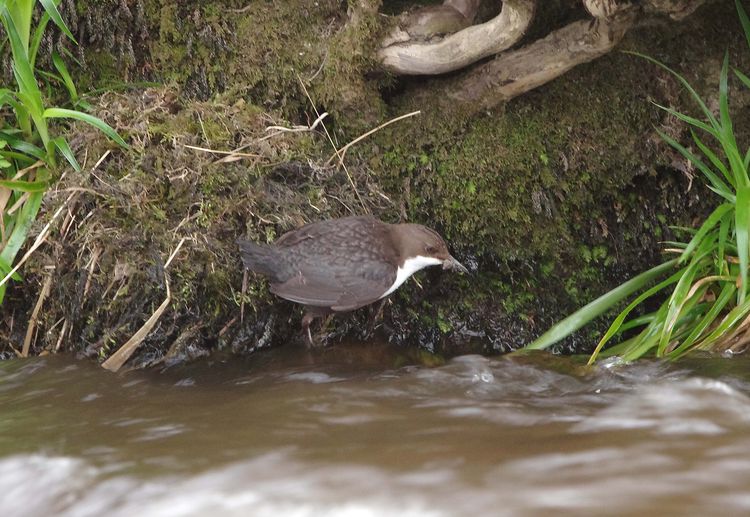
I poked the camera back through the hole, hastily but carefully but now with the camera off the tripod it was going to be hard to get sharp images, but that's the way it is and you make the best of it. The bird, a female I am sure, stood for a second or two and then started to fish which, although I have seen it many times before, was very interesting. It struck me that it was very successful because in just a minute or two it caught two different prey items. I have no idea what the first item was but it looked like a shrimp of some sort...... how could that be?
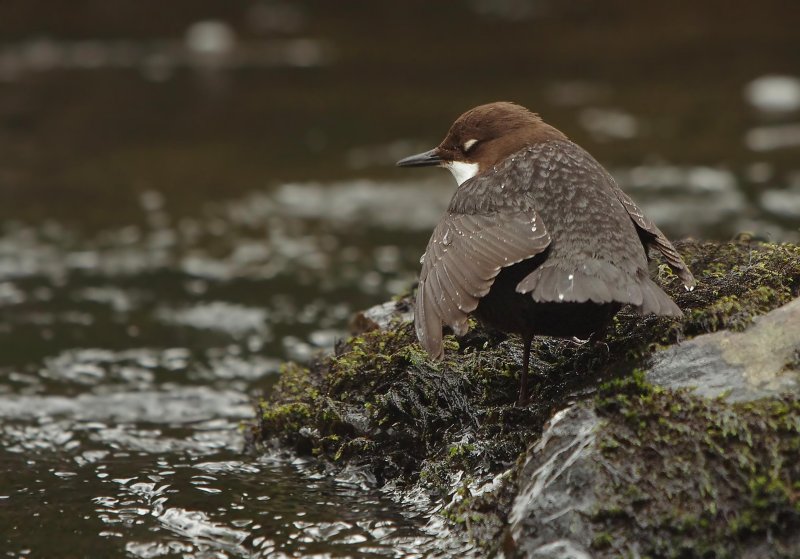
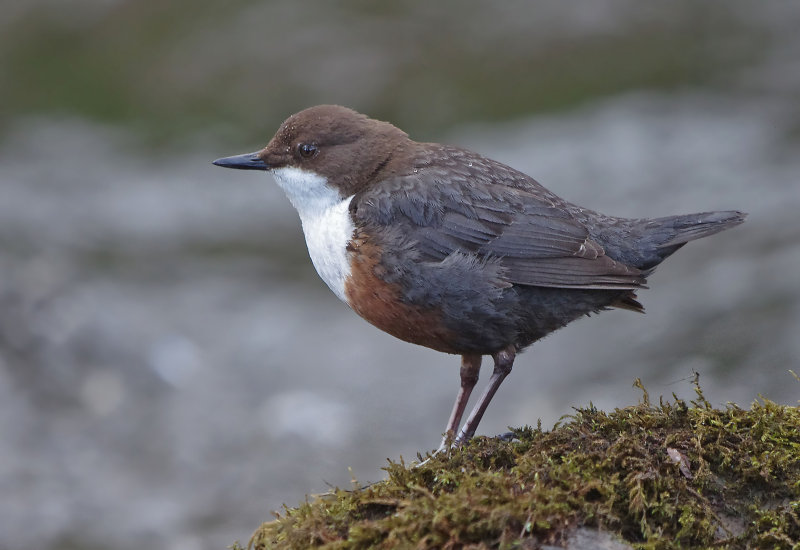
Dippers are as comfortable in the water as they are out of it. Can you imagine how they keep warm in the cold water? They have special adaptations in the blood and also, very dense plumage. The feathers are more robust than birds of a similar size and you can see these feathers on the back. Look very closely at the white edgings to the wing feathers of this bird. This is probably an indication that this bird is one hatched last spring as young birds are known to have these white markings to the edge of their wings. Next year these white edged feathers will be replaced by all dark feathers.
This bird continued to feed around the waterfall and hide for about 10 minutes and was silent for the entire time. Suddenly it was joined by a very noisy singing bird, obviously the male and then they both left upstream together reinforcing my belief that this was the female.
19-FEB-2013 male sings.
Nesting hasn't begun yet.
I well remember that this time last year, and for that matter, the year before, I saw Grey Wagtail regularly when I was waiting in my river side hide. This of course, is no surprise because both species have almost identical habitat requirements and anywhere that Dippers are found, Grey Wagtails will be close behind. They are even known to nest next to each other, that is, close to, or above water, under a bridge or behind a log and so on. However, it is fair to say that Grey Wagtails are a little less demanding and they can be found along the banks of muddy rivers and streams which is a habitat that no self respecting Dipper would ever frequent. So the rule is probably this, find a Dipper and Wagtails will be near, but finding a Wagtail will not necessarily find you a Dipper. At this time of the year the males, who have a breeding plumage and an eclipse plumage are just starting to attain the solid black bib that they only have in the height of the breeding season. They are quite noisy at this time of year and one bird has just displayed in front of me, singing a song and then parachute gliding with fluttering wings from rock to rock. It was literally on the rocks on the waterfall just in front of me and I managed one or two photos, one particularly good one when he was in the middle of his noisy song.
I walked back up river after a couple of hours and was pleased to see a Dipper not that far from the hide. It was singing away loudly from a boulder that I must have seen a Dipper perched on at least 100 times in the last 3 years. He saw me even though I was 25 metres away and then flew up to another favourite Dipper boulder. He disappeared from view and then as expected, doubled back to fly down towards the hide. It wasn't many seconds before I saw another, this one was much more silent, obviously a female and just like the male she doubled back to fly down stream to join her mate. How many times have I seen that? In short, there was no obvious nesting behaviour observed today.
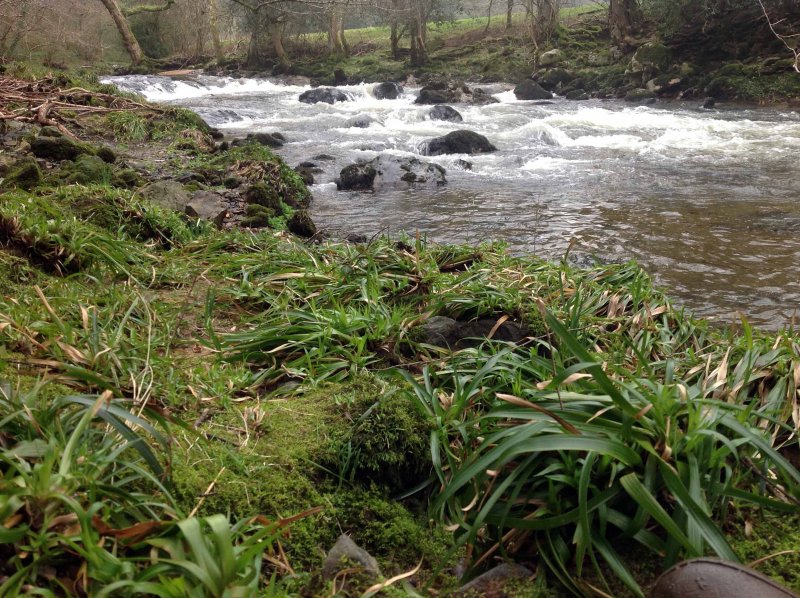
Taken with iPad
Day 2 of the Devon Dipper Diary 2013
It's still early in February, too early for any real breeding to have begun so I don,t know what I really hoped to achieve when I made my way to the Dipper hide this morning. I had restored it back to ship shape yesterday and I was keen to try it out I suppose. Frankly, I had been just a little bit deflated yesterday when I didn't see Dippers in last years territory. So, when I picked my way down the river towards the hide today, I asked myself that very question.The answer was simple, I just wanted to check on things and keep abreast of any behaviour and be there when activity started. I was feeling confident though. Nothing has changed, Dippers have been breeding here on this stretch of the river for who knows how long, it could be thousands of years? Why should 2013 be any different. So when I saw a Dipper feeding just ahead of me as I walked down the river, I was pleased but not surprised in the least. It did the usual thing once it had seen me. It flew onwards to a safe distance, then as I get nearer I saw and heard "him" singing, yes it was a male and the singing confirmed it. My presennce "moved" him on further down stream in front of me, hopping accross from boulder to boulder. Then suddenly he turned back and flew past me and up river again, singing and calling loudly. This turning back usually indicates that a bird has reached the edge of it's territory but who knows at this stage of the season. I tucked myself under cover in the hide, it was cramped and still needs lots work to make it ideal but I was concealed at least. It wasn't very long before I heard a familiar noise and not one, but two Dippers flew down stream and past the hide towards the area that they had bred last year. A broad smile lit my face, perhaps this year is going to be a good one after all.
I waited for ages for them to return to the weir and the hide to feed. It was cold and my originally warm legs got colder and colder, I should have worn more clothing. The cramped hide wasn't giving me good views and eventually I exited, mainly to get warm again. But I had stupidly broke rule number 1. That is, always double check to see if there is anything close by before you emerge because there, perched on the weir and just to my left, 10 feet away was a Dipper! Murphy and his law in action yet again! Still not to worry, I now knew that indeed, nothing was different whtsoever about 2013. Having further re-arranged the hide so that when I go back in the next few days I will not be so cramped, I walked back up river towards the car. I saw even more Dipper, one more bird, again flying down river singly..... that made three, and then a very interesting piece of behaviour. Two Dippers flew towards me from up-stream calling very noisily. When they were just past my position, one turned and flew back from the direction it had come giving me the distinct impression that this was a territorial dispute and one bird had been "escorting" the other off it's patch. So now that made 5 different birds seen today. Obviously territories are not yet settled. It had finished up a good session and well worth the effort (and cold).
The first observations of 2013
I had been waiting for the water levels to retreat just a little before I started this year's observations. When I arrived at the site I was pleased to see that last year's hide was still standing and even though it was now, just a collection of camo material and sticks I managed to reform it back in to an acceptable hide. This is positioned over-looking a nest which remains from previous years, although not the one that they had used last year. This is my third year of studying Dippers on this stretch of river and in previous years I have discovered so much about their breeding behaviour. Comparing my notes, it was around this date last year when signs of breeding activity had commenced when I had seen two birds together. Activity had gradually increased in intensity as the month progressed. Today I was slightly disappointed not to see a bird in front of, or near the hide but this could have been due to a couple of reasons. Firstly, the water level is much higher than it was last year and looking at the bankside vegetation it seems that the water has been consistently higher than in previous recent winters. Also, in previous years the birds had been absent from the nest area during the late morning and afternoon and as my visit was in the late morning today this would follow the same pattern so I am not too concerned. On a large mid-stream rock that I know as a favourite perch I could see droppings which looked fresh, so it appears that Dippers had been in the area very recently. When I walked further down the river to the adjoining territory I had a close encounter with a Dipper and it was nice to see one for the first time this year.
19-APR-2012
Dead chicks!
Regular readers of my blog will know that I hae been monitoring, photographing and recording the events at a White Throated Dipper - (cinclus cinclus) nest site since the end of February. My almost daily visits and a total of well over 100 hours have recorded many interesting facts and I have gained a real understanding of the behaviour of this most iconic and interesting species. I am attempting to put together a book, a "Devon Dipper Diary" which will be published either in the traditional way or/and online as an iPad app or online book. Things were going so well until yesterday when 20.8mm of rain fell near to the river's source miles up stream which led to an almost, flash flood. The water level rose at an unbelievable rate, flooded in to the nest and prevented the parents from gaining access. The water level quickly receeded but by then the damage was done and the chicks were cold and lifeless in the nest. However, at that point they were not dead. I warmed them with my own body heat until they became active and then, having made a new access hole to the nest, above the water line, replaced them. The parents quickly returned, and now able to get in to her chicks, the female tried to brood them and the male continued to bring food. Sadly all to no avail as this morning, with the river level down 2 feet again, the chicks at 7 days old were dead in the nest. Their eyes were just about to open and pin feathers were about to emerge from their wings.
18th April 2012
The nest gets flooded out!
Getting straight to the point...... the Dipper chicks are with 99% certainty, dead!
It had rained a little bit off and on all day but by 4 pm it had brightened up. I had always planned to visit late afternoon and early evening. As I walked across the field and reached the river, immediately my heart sank, the water was so high it was lapping at the bottom of the nest. I saw a Dipper nearby so I didn't immediately think that it was a full blown disaster. I quickly concealed myself and then looked properly, there was no entrance hole visible, this was under the water. The majority of the nest was not submerged though. I sat and waited to see if the parents came and it wasn't long before the male arrived with a beak full of food. As you can see, he perched on the nest and tried to find a way in to feed his youngsters. It was a pathetic spectacle as he searched around the nest, all he time with a beak full of food, trying to get in to the nest. I quickly made a decision, I decided to cross the river and planned to open up the top of the nest so that the birds could get in to their chicks. It was either give them that chance or let the chicks perish for certain, if they were not dead already that is. I ran back across the field and down the road to cross by some stepping stones but when I got there the stones were totally submerged as well, I had no way of getting across the river! There was another way, via a bridge quite a way upstream which is what I did. I made my way down the side of the swollen river being careful not to fall in and eventually some 30 minutes later I was at the nest which was just below me. I lowered myself down head first towards the nest, holding on with my left hand and praying not to fall in to the torrent. I poked through the top of the nest and sadly I could feel the stone cold chicks, lifeless and seemingly dead. I removed them one by one, cupped them in my hand and blew on them with my warm breath. Miraculously, after 5 minutes or so there was some tiny movement and they started to come back to life again. I was really heartened by this, with them in my hand I put them in to my arm pit and held them next to my skin, the warmest part of my body. I had them there for 20 minutes trying to bring up their body temperature. However, I needed to get them back in to the nest as soon as I could so I took the decision to put them back in and hope for the best. I tidied up the new entrance hole and retreated back the way I had come. Back at the hide opposite I watched and waited, and prayed. Suddenly the female arrived at the nest, after some investigation she entered through the new entrance and to my utter amazement and joy she seemed to start to brood the chicks. At one point she did some tidying up of the new entrance and later even emerged to catch some food which she took in to the nest. Whether she fed that to the chicks I will never know, were they alive or had they continued to lose body heat again. After quite a while the male returned to the scene with a beak full of food, he tried on several occasions to feed his youngsters, perching on the edge of the nest calling to them loudly but sadly he didn't feed them. I am guessing because they didn't gape for food which was a really bad sign. I am praying that the female was able to brood them enough to get them active again but I will not know the answer to that until the morning. I appreciate that it is almost certainly against the law to take chicks from a nest but my conscience is clear on this. I have been with this family of Dippers for 7 weeks, almost daily and watched them build a nest, watched them incubate and watched them feeding their chicks for the last 7 days. It would have been impossible to sit and watch them perish without trying to help. Perhaps I should have let nature take its course? But I didn't, I did what I think is right. However, the chicks have almost certainly died in the nest. The parents were unable to brood the chicks or feed them for several hours. There is a very small chance that my intervention may have saved them but I am not hopeful. If they have survived it will be an absolute miracle.
17th April
A worrying rise in River level.
I was horrified when I went to the nest site late this afternoon. Last night it rained, not hard, but enough to leave puddles in the road. I guessed that the river would have risen but I wasn't prepared for 2 feet higher though. Every boulder was completely submerged and the river was a torrent. The Dipper nest was now 1 foot above the waterline but still reasonably safe. The parent birds were a litle subdued, they flew in with food, aiming for their favourite boulder perches and then at the last minute they would suddenly realise that it wasn't there anymore and veer away to land opposite. Yesterday they carried food to the nest every few minutes but today they were feeding much less. At one point the male was away from the nest for quite an extended period, at least 40 minutes. The female brooded the chicks for longer periods than yesterday but did emerge from time to time and carried food to them as well. I left the site reasonably content that everything was fine and with the knowledge that the oldest 3 chicks are 7 days old tomorrow. However, the weather forcast is not good, more heavy rain is on the way, yesterday's rain had added two foot to the river level, if that happens tonight then I fear that the nest will be flooded out and that will be the end of it. I am keeping everything crossed that they remain safe. Nature is extreme and always takes it's course.
Monday 16th April
But more about yesterdays watching which was incredibly interesting. The chicks are doing really well, I peered in to the nest which wasn't too hard because the opening has become larger due to constant use and the male's habit of hanging on as he feeds his chicks. I could see them really well and also noted that, at 5 days old they have trebled in size already. Feeding by the parents is none stop and at times both birds were back and forth in less than a minute, constantly feeding the obviously voracious youngsters. The female left-off from brooding and hunted for prey right in front of the nest, taking just seconds to find prey which she delivered, flopped back caught more and then delivered that morsel about three times in a minute. The male however seems to spend comparatively longer catching food and when he comes back to the nest he is usually carrying larger insects such as mayfly. Yesterday I saw him catch a small fish which he dealt with, Kingfisher-like, beating it to death, he didn't bring that to the nest but flew opposite to eat it himself, incredible that he could make the judgement that it was too large and not suitable for the nestlings. There seemed to be an uneasy relationship between the parent birds, at one point they displayed to each other and then tumbled in to the water rolling around as though fighting but is more likely to be a precursor to mating?
15 April, Dipper chicks day for
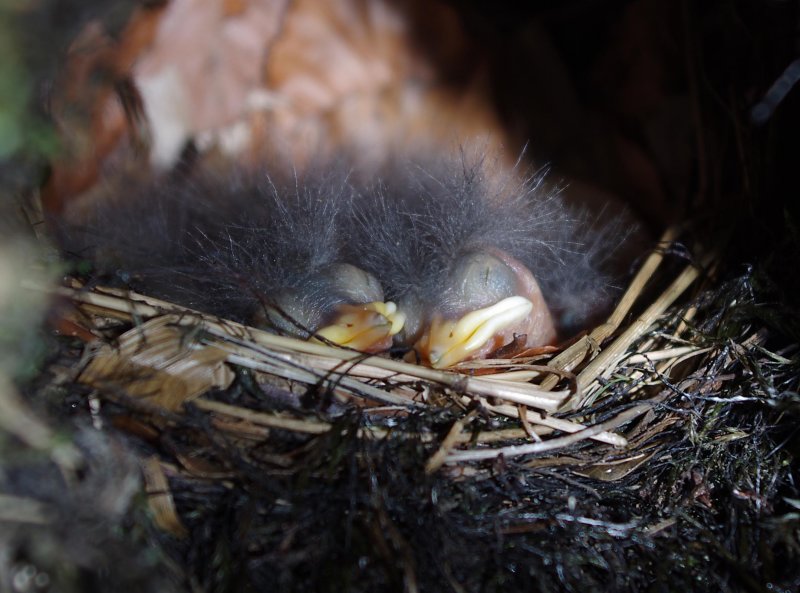
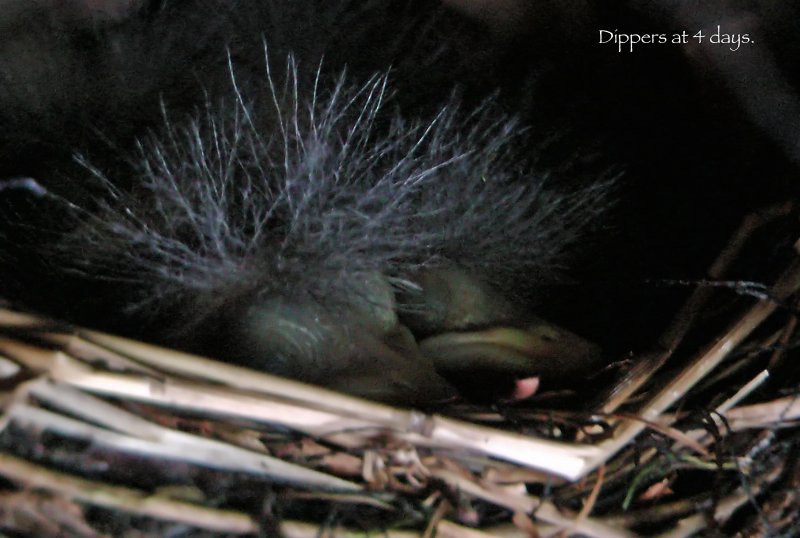
I had my first opportunity to photograph the baby Dippers today and I am very glad to say that everything is progressing splendidly. I watched from under cover nearby and with a clear view of the nest then as soon as the female left the nest and flew up river to feed I took the opportunity to check the nest. It is not necessary for me to do this daily but I am keen to know if the chicks are thriving. By using a small LED light I can see the chicks in the nest quickly without too much disturbance. The chicks, all 4, are now covered in very long charcoal-grey down, they are darker than they were on the day of hatching. I have been able to record some interesting behaviour today. The female left the nest several times in the 2 hours that I was watching this afternoon, not only to feed herself but also returned with food to carry back to the nest. This is a contradiction to other descriptions of breeding Dippers that I have read that suggest that the female does not help to feed the chicks until they are at least 10 days old. In this pair the female is already deffinitely helping to feed the chicks in the nest today and the chicks are 3 and 4 days old now. The male in particular is very industrious and constantly, either food or delivering it to the nest. There is going to be a video clip posted in the next half an hour so please check back.
13-APR-2011
Four Dipper chicks doing well.
At the nest this evening it was good to see the male working like a demon collecting food for his 4 chicks. What struck me was not only how efficient and skilled he was at finding food, but how much available insect life there must be. I kept a really accurate record of the time between visits to the nest. In 41 minutes from 18.11 to18.51, the male visted a total of 10 times. I have to confess that this level of feeding far exceeded what I expected. The prey being fed is larger than I expected and seems to be mainly Mayfly as I expected it would be.
11-APR-2011
Thursday 12 April, the 4th egg hatches.
Yesterday I had discovered three chicks and one unhatched egg in the nest. When I checked again today there were 4 chicks. This confirmed a few important facts. Incubation had been 17 days. Finding just 3 chicks in the nest yesterday and a 4th today could mean only one thing. Incubation had begun after 3 eggs were laid and before the clutch was complete. One of the things that I wanted to acheive by watching and studyng this pair of Dippers in the intense way that I have , was to establish my own facts rather than rely on other peoples research and information which is often recycled, 3rd hand information rather than anything based on private study. All previous information that I have read, told me that incubation would not start until the clutch was complete, in other words, after the 4th egg. This is to ensure that all the chicks hatch on the same day and have an equal chance of survival, However, this clearly is not the case and 3 chicks will have a head start on their younger sibling. In times of food shortage, the younger chick in the nest would certainly perish but in a season when food is plentiful this is not an issue. The male bird is already proving to be a brilliant father. I watched him for an hour tonight, he was working almost tirelessly catching prey undrwater and then delivering it to the chicks. At one point I counted to 30 before he emerged again, but mostly he would spend just a second or two delivering his morsel. he seems quite happy to catch food from around the nest so this will give me some great opportunities to watch him feeding as well.